Reading at the Crossroads

Reading at the Crossroads is an archive for columns and letters which appeared in the Terre Haute Tribune Star. I also blog here when my patience is exhausted by what I feel is irritating, irrational and/or ironic in life. --gary daily

My Photo
Name: gary daily
Location: Terre Haute, Indiana, United States

The material I post on this blog represent my views and mine alone. The material you post on this blog represent your views and yours alone.

Thursday, December 29, 2005

Remembering Henry Noll aka Schmidt

[gary daily col. 32 September 1, 2002]

“In the past, the man has been first; in the future the system must be first.”
Frederick Winslow Taylor, 1911To the public his name was Schmidt. In 1911 he was the most famous common laborer in the world.
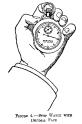
Although mechanization entered the factory workplace prior to the Civil War, the work of the common laborer was still strictly muscle work. Large and heavy lumps of goods and materials were jostled about, huffed into warehouses, and sweated onto wagons and trains. Schmidt set a standard for this kind of work. In doing so he played a major role in making all work a part of “the system.”

In his magnificent book The Americans: The Democratic Experience, Daniel J. Boorstin argues that “Efficiency” which begets higher productivity is what American industry in the twentieth century was all about. Frederick Winslow Taylor formulated theories for packaging work into efficient units of time in the quest for higher productivity. Taylor always put an emphasis on that most magic of twentieth century religions, “science.” The laborer Schmidt was held up to the world as one of Taylor’s marvelous converts, a model scientific and efficient unit.

In 1899, Taylor rounded up a dozen workers in the Bethlehem Iron and Steel yard, showed them a pile of “pigs” (gray iron bars weighing ninety-two pounds each), took out his stop watch and ordered these laborers to work as hard as they could picking up the heavy bars and carrying them up a ramp into a railroad car. They loaded one car, 16 1/2 tons total, in fourteen minutes. Extrapolating from this forced-march demonstration, Taylor calculated an optimum of 71 tons per day for each laborer. Normally these hand-picked workers might load a car in 54 minutes; a ten hour day’s work came to around 24 tons per man. Many at Bethlehem loaded less than this each day. All were paid $1.15 per day.

After Taylor had this raw calculation of 71 tons per day in hand, in a very non-scientific way, and without comment in his final report, he upped this figure to 75 tons! Now he was ready for the next step, a piece rate pay schedule. For reasons never explained, and again departing from anything resembling the rigors of science, Taylor set 45 tons per day as the standard stint of work for what he termed the “high priced man.” Laborers reaching this level would be paid the munificent sum of $1.70 for the day’s work. The pay for what now was arbitrarily designated a “normal day’s work” of 24 tons would receive $1.15. Those able to wrestle only 13 tons of iron from pile to rail car (and previously this was the historical average in the yard), would be paid fifty cents for their day’s work.

Ten men defied orders to work under this system. On Taylor’s authority they were discharged.

Robert Kangiel’s definitive biography of Taylor, The One Best Way, describes what happened next. Seven men were specially recruited to work under the Taylor pay system. They worked individually, no longer as a gang. One man, Schmidt, loaded 45 3/4 tons of iron. The others all fell short of the “high priced man” standard Taylor had set through his “scientific” investigations. They quit. Over the next ninety days loaders would come and go. Some lasted a few days, some not even a day.

Kangiel quotes from the report issued on this scientific experiment in “Efficiency”:

“We found that [Gruen] was not fitted for such heavy work.”

“Roth on this day loaded 43 tons, earning $1.63, but after this day did not return”

“Koch and Howarth [claimed] that they could not earn a fair day’s wages at this work.”

In the end, a total of forty workers took part in Taylor’s peculiar scientific study of work rates and pay levels. Only Schmidt stayed on to work the next day and the next and the next. And only Schmidt, joined by two others later in this experiment, qualified as a “high priced man.”

Today Taylor is lionized in management texts assigned in schools of business. An example at random: Ricky W. Griffin’s Management (7th edition), a course text currently assigned in a Indiana State University course, includes a picture of the stern scientist of management with this caption:

“Frederick Winslow Taylor was a pioneer in the field of labor efficiency. He introduced numerous innovations in how jobs were designed and how workers were trained to perform them. These innovations resulted in higher quality products and improved employee morale. Taylor also formulated the basic ideas of scientific management.”

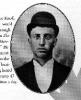
Kangiel’s research found “Schmidt” to be the scientific stage name Taylor hung on a worker whose real name was Henry Noll. In his The Principles of Scientific Management, Taylor describes Noll as “a man of the mentally sluggish type . . . his mental make-up [resembling] the ox rather than any other type.”

Henry Noll the man, not Taylor’s management science unit, was twenty-eight years old at the time he was running slabs of iron from pile to box car in Taylor’s experiment. He was a jogger. Every day he ran a mile or so to and from work. Native born of Pennsylvania Dutch heritage, he could read and write. Noll was a volunteer fireman. It was said of him that he was trustworthy and a good saver. He looked to the future. In 1960 a small one-and-a-half story clapboard house with a failing foundation in Martin’s Lane, Bethlehem, Pennsylvania, was torn down. Henry Noll had purchased the land this house stood on in 1899. He built this sturdy house alone on time he managed to squeeze from his long and arduous days of work.
Congratulations and happy Labor Day to the workers of America.

You know who you are even if the Frederick Winslow Taylors of the world do not.

Wednesday, December 28, 2005

Will Bush Face Down the Velcro Heads? Nah. Won't Happen.

[gary daily col. 31 August 25, 2002]


Men their rights and nothing more; women their rights and nothing less.”
-Susan B. Anthony and Elizabeth Cady Stanton, The Revolution (1868)

Tomorrow is “Women’s Equality Day, 2002."

This day of recognition marks women’s enfranchisement. With the passage of the 19th Amendment to the U. S. Constitution in 1920, the long struggle for women’s rights in this country took a giant step. There is plenty to read in conjunction with this significant moment in the history of representative democracy, but what I’m really hyped about is hearing President Bush’s official proclamation on this auspicious day.

In his 2001 address on this event, Bush had this to say:

“In 1840, Elizabeth Cady Stanton met Lucretia Mott at the World's Anti-Slavery Convention in London. They, along with the other women there, expected to join in the anti-slavery proceedings, but male delegates refused to allow them to participate. Thus rebuffed, Mott and Stanton began a journey that would lead to the 1848 Seneca Falls Convention. There, the Declaration of Rights and Sentiments called for women's equality, including the right to vote and to take part in our Nation's great moral debates.”

The president went on from there: “Tremendous advancements have been made in the fight for equality. But we must remain diligent in enforcing our Nation's laws. And we still have work to do in this area.”

Until I read this speech, I had no idea Bush was such a student of women’s history and such a watchdog and advocate of women’s rights. I guess those campaign ads of solitary, square-jawed Bush striding through west Texas, kicking up dust, and some highly questionable appointments and challenges to Title IX of the Educational Amendments of 1972 gave me the wrong impression of the man.

Well, thanks be to Ma Barbara, or to the well read Ms. Laura Bush, or simply to intelligence trumping ignorance, here’s “W” singing the glories of the free-thinking Stanton and the peace loving Mott. But above all, here’s our Skull and Bones Yalie and Harvard MBA, moving toward a full-blown endorsement of that famous radical feminist manifesto of 1848, the Declaration of Rights and Sentiments. I hold my breath waiting to hear what the president will have to say this year. It makes you wonder just how long “W” has been a cross dresser on women’s rights, a closet feminist!

Feminist!

I can personally report on strong reactions to this word even after Bush's Presidential proclamation last year. In bar rooms and classrooms, during town and gown functions, or while striking up an innocent conversation while standing in a supermarket line, the mention of feminism turns some perfectly good brains into a hollow organ lined with velcro. I call them Velcro Heads. Their thinking on advocacy for women consists of grabbing anything and everything in the news conceived of as being threatening, other, not us, dangerous, irreligious, different--and let’s not leave out those old standbys-- “extreme” and “radical” and attach it to the f-word.

And this is why I am in awe at “W’s” wandering so close to the edge of enlightenment during last year’s Women’s Equality Day. Will this be the year he fully embraces feminism?

Feminism!

Can you remember how this term helped to create that cover boy of a few years back, the Angry White Male? Men were taking to the woods in packs. They were smearing themselves with mud, 30 weight motor oil, bean dip or anything they could get to stick to their sweaty bodies that might keep the testosterone from leaking out. Through long nights forests throbbed with the sound of beating drums. All of this in a frantic effort to ward off the insidious power of mothers, wives, sisters, daughters, and other assorted female types who were bent on weakening Manhood. Action of this intensity had not been seen since the skies of Old Salem Village were darkened by soaring feminists.

Feminists.

There’s a demographic out there that has trouble distinguishing demonology from democracy. For them, grudgingly, votes for women has become acceptable. They feel the pace leading to that radical change was just about right-a 72 year struggle to win the vote followed by an 82 year trial period. But now Velcro Heads are asking: Who could have possibly stamped an “OK” on Bush’s August 26, 2001 speech? They feel it’s one thing to sniff tolerantly at the agents of radical change, but let’s not encourage “them.” So tomorrow is Women’s Equality Day. And Velcro Heads will be reading President George W. Bush’s official 2002 Proclamation with as much interest as feminists.

Feminism.

In the meantime, and anytime, I recommend reading the primary source cited in President Bush’s 2001 shocker, the Declaration of Rights and Sentiments. It famously begins with a paraphrase of the Declaration of Independence: “We hold these truths to be self-evident: that all men and women are created equal,” goes on to state details of man’s tyranny over woman, “submit [s these facts] to a candid world,” and concludes with a dozen resolutions that feminists have been striving to achieve in letter and in spirit since 1848.

I would like to see President Bush further bolster his sub rosa credentials as a feminist. He should read those famous twelve resolutions into his Women’s Equality Day, 2002 proclamation. He might also try saying out loud in public the word that ties so many minds into empty emotional knots--feminism.

An Occupation Once Called "just running around”


[gary daily col. 30 August 8, 2002]

Were we closer to the ground as children or is the grass emptier now? -Alan Bennett

Children do not give up their innate imagination, curiosity, dreaminess easily. You have to love them to get them to do that. -R. D. Laing

With summer coming to an end and the “Back to School” sales hoopla taking over the malls and mega-stores, kids are starting to feel the hot breath of formal education on the backs of their necks. And some of these kids are feeling and thinking, what’s the difference--schools are about adults and summers are about adults. Kids like these are not just showing signs of creeping cynicism, they’re reporting on the reality of their lives.

This thought was reinforced again while I was re-reading two favorite books, Harper Lee’s 1960 classic, To Kill A Mockingbird and Robert Paul Smith’s less well known, Where Did You Go? Out. What Did You Do? Nothing. Lee’s novel, serious and significant, is set in the southern Alabama town of Maycomb in the early 1930s; Smith tells funny, wildly exaggerated stories of his urban youth from the perspective of fifties suburbia. The coming-of-age theme is an important part of the Lee novel. Smith’s stories carry a not very subtle subtext of worry about how children are growing up in 1958, the year his book was published.

“Scout” is Lee’s child heroine. Her nickname says it all. She’s the curious, brave, tough, try-anything younger sister of Jem and the friend of a regular summer visitor to Maycomb, Dill. In brief, here’s a hint of their summer: “Routine contentment was: improving our treehouse that rested between giant chinaberry trees in the back yard, fussing, running through our list of dramas based on the works of Oliver Optic, Victor Appleton, and Edgar Rice Burroughs. . . . But by the end of August our repertoire was vapid from countless reproductions, and it was then that Dill gave us the idea of making Boo Radley come out.”

No need to fill in any blanks. These kids amused themselves with kid games thought up by kids and carried out by kids. And that “fussing” hints at times filled with unsupervised discovery. As Lee amusingly and ominously puts it, when they grew tired of this they went looking for something more exciting to do.

Today the Apprehensive Adult Authority of the Universe would be quick to say Scout and company went “looking for trouble.” Motivated by a trust shattering mix of guilt and fear, a duly constituted Apprehensive Adult Authority Action Committee would create still another “summer program” or sports league or play circle. Firm in the knowledge that the devil has plans of chaos for youth with idle hands and inquisitive minds, these programs are designed to keep chaos at bay by providing the glue of schedules and the protection of supervision.

This is all an unfair caricature. But it’s a picture that does capture some salient truths. When Smith wrote his paean to unfettered youth in search of fun and “trouble” back in the good old days of the 1950s, the slope toward Palm Pilot child rearing practices was just showing up on the cultural screen of American life.

We should never take Smith at his word. But even discounting his tales by 90% for hyperbolic humor, he still leaves us with the impression that his childhood years were spent profitably pursuing activities few parents today can imagine, let alone tolerate. Some of these were building forts in vacant lots with scavenged and “loaned” building materials, engaging in a wide range of games that required no equipment and no insurance releases, cutting worms in half, dropping things down storm drains, spitting, playing mumbly-peg with knives bristling with many blades, and enjoying a game of baseball played with less than nine players on a side, no uniforms, and with a ball wrapped in friction tape. Smith candidly reveals, however, that time was mostly spent “pursuing the occupation called ‘just running around.’”

Mythic Golden Ages abound in history and especially in memories of our youth. All are true in a fashion; all are lies at the edges or the core. They are built through a selection process that delivers up pleasure rather than pain. We grudgingly grant this in recognition that we can’t turn the clock back to those innocent, interesting times that never really existed.

But still, we feel pangs of memory or longing when we read about the no-strings-attached seasons of play and discovery enjoyed by Lee’s “Scout” and Smith’s childhood self. Our kitchen calendars can underline this feeling. Have the days and weeks on it been transformed into a personal corporate-style flow chart on speed - filled beyond the margins with initials, times, and cell phone numbers? And what answer do we get from our children or grandchildren when we ask, “What have you been up to?” Do they say “fussing” with the assurance of that always curious keg of energy, “Scout”? Is their response edgy with self-reliance as Smith’s “just running around”? Or do they wearily point up to the calendar on the wall?

Tuesday, December 27, 2005

What Will $37 mil Buy?

[gary daily col. 29 August 11, 2002]

. . . the big fellas are being hydrated like petunias in every training camp under the blistering sun, so all must be well. -Selena Roberts, “In N.F.L., Wretched Excess Is Way to Make Roster”

Was it H. L. Mencken who wrote that Puritanism is the haunting fear that someone, somewhere, may be happy? In this sense, the following may come off as puritanical. But really, all I’m inquiring into are football fan’s powers of imagination, their ability to confront and deal with reality. So, as TVs prepare to blare each Monday night, “Are ya ready for some . . . (Q. & A)?”

Q. Can you imagine what it’s like to strap on the ol’ pads, those space age foam and fiber shock absorbers developed in high tech labs, fitted by computer body imaging, and all snugged into the sausage casing of 100% polyester dazzle cloth?

A. Only if you’ve done it yourself and haven’t suppressed the memory. Or, and this is a likely possibility, if you’ve watched more hours of TV football than there are chapters in a shelf full of books.

Q. Can you imagine crisp October afternoons on the ol’ gridiron when it’s August and ninety degree temperatures and an eighty plus humidity level turns the ol’ turf, that’s astro to you bub, into a 120 yard long by 53 1/3 yard wide heating pad?

A. Probably not. Most sports reports are long on statistics but weak on pain and suffering. And, while heat-related deaths on football fields are solemnly reported, like the “Injury List” news, this stuff is deflected as easily as 99 per cent of the “Hail Mary” passes thrown each season. Clichés cover it: “you have to play hurt” or “the best players suck it up when they’re hurt.”

Q. Can you imagine ol’ coach gathering the squad around him at the start of that first practice, fixing each and every player with that steely eyed look of his, and telling them, in his best God/Father/Friend voice, that who they are in life, and what they can be in life, depends on what they do this very day, this very week, and this very season of their lives?

A. Probably, yes. You’ve seen the movie. Your chest swells involuntarily. This is character building. No one seems to wonder why so many athletes, given all this special, very high-priced attention, turn out to be violent social misfits.

Q. Can you imagine ol’ Chicago Bear fans gathering at neighborhood taverns around the “city of big shoulders,” filling the trunks of their cars with beer and brats and hurtling down US 57 to Champaign-Urbana where the pros of the NFL will play on a field maintained by one of the pros of the Big Ten (sic)?

A. Sure you can. These lovable lugs became famous on “Saturday Night Live.” They love “Da Bears,” hate “The Pack,” and carry pictures of the sainted Ed Sprinkle in their wallets. They work hard for their money, and after Soldier’s Field is refurbished, they will have to work even harder to afford the price of end zone seats.

Q. Can you imagine what a little ol’ $37 mil is buying the University of Colorado in Boulder?

A. No. It’s not a library or arts complex. It’s not a law school addition honoring ol’ Coach Fred Folsom for his decades of coaching the Buffaloes while, get this, he was also a law professor. That $37 mil will pay for 41 luxury suites and 2000 “club seats” at the stadium bearing Folsom’s name, at least until a corporate sponsor turns up.

Q. Can you imagine how much it’s going to cost a party of Colorado “Buffs” rah-rah fans to view football games from one of these luxury suites?

A. You’re way too low. Try $50,000 in long green. Probably three times what Coach/Professor Folsom earned his last year as a teacher/coach in 1944.

Q. Can you imagine what the ol’ Knight Commission on Intercollegiate Athletics has called expenditures such as these?

A. No. Not “obscene.” Their report calls it an “arms race of spending and building in intercollegiate athletics.” And as with all such races, who ever really win an arms race?

Q. Can you imagine how many ol’ college sports programs are on probation? How many ol’ athletes end their seasons in court, on crutches, without degrees, or even dead? How much of your ol’ tax dollar goes to paying the bills for skyboxes, luxury suites, and “club seats”?

A. Neither can I. Is anyone counting? Why not?

Q. Can you imagine any ol’ stories by fine writers that touch on any of this, especially on how it all might play a part in the large scheme of things or in the lives of individual athletes?

A. Not many? Try reading Irwin Shaw’s great short story, “The Eighty Yard Run.” Or look for the part on basketball in Rabbit, Run, by John Updike. Not to be missed is E. L. Doctorow’s perceptive and moving take on turn of the century baseball in his wonderful novel, Ragtime. Most of all, promise yourself to read James A. Michener’s (yes, that Michener) Sports in America-a report from a man who loved sports enough to spell out its flaws and failings.

Personally, I grew up on John R. Tunis’s sports fiction, Sport magazine’s” hagiological journalism, and the tall tales Bill Stern’s radio sports program dished out each week. That’s why I can’t seem to break the habit of talking and writing about ol’ this and ol’ that. It’s been the business of the sports business to not just create fans but to manufacture mindless myths, synthetic traditions. They’ve done their work too well.

Cussed and Discussed

[gary daily col. 28 August 4, 2002]

"When I re-read 'Uncle Tom's Cabin,' I was 45 and I thought I would have to hold my nose to get through it. But by chapter two, I was gawking, it was so interesting and terrific. By the end I was in awe.” -Jane Smiley

Do books change lives?

There’s no doubt they do when we speak of individual lives. Today I read a short account of a University of Virginia philosophy professor testifying to this Paul on the road to Damascus phenomena. The story of his adolescent years left me with the impression that he was doomed to a life of living off inflated memories of his high school football exploits and the proceeds from stolen hubcaps. Then he’s turned around. He reads Ken Kesey’s anti-authoritarian novel, One Flew Over the Cuckoo’s Nest. It’s goodbye bars and cars and hello Plato and Vico.

Why do I so often find myself involuntarily thinking “yadda, yadda, yadda” when I hear these accounts? I am pleased but never surprised by “reading saved my life” stories. I know full well there’s always some one individual flapping about in the flock of humanity who will go to his grave certain that reading Jonathan Livingston Seagull gave wing to his previously earthbound heart and spirit. I would never take serious aim at gulls wanting to be eagles.

That a book can change a person’s life is a profound reality; it is also a truism. But I suggest taking a different tack in regard to the power of the printed word between covers. Try this question: What book has had the power to grab an entire nation by the collective scruff of its neck and move a whole people to a different place in their minds and their actions?

In answering, please disqualify those sacred texts which abound in the world. Also exclude sacred secular works, including the dearly departed Sears and Roebuck Catalog and any and all biographies of NFL quarterbacks, Brittany Spears, or honest CEOs. The demonstrated power of these volumes places them beyond discussion.

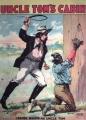
Limiting yourself to American works, you might come up with titles such as Rachel Carson’s environmental classic, The Silent Spring; the book that sparked a war on poverty, Michael Harrington’s The Other America; Betty Friedan’s signal at the start of the second wave of feminism in American history, The Feminine Mystique; or Ralph Nader’s Unsafe at Any Speed, that safety beacon in the dark corporate night of negligence. These are all worthy and important works. But if your grasp of history allows, the one book that would appear on almost every list would be a 19th century novel--Harriet Beecher Stowe’s Uncle Tom’s Cabin.

This book was published 150 years ago, in 1852. (Strictly speaking, it was first serialized in an antislavery newspaper in 1851.) It’s my guess that it would be impossible to find a history book surveying this nation’s history that does not mention Stowe and Uncle Tom’s Cabin as a contributing factor in the coming of the Civil War. Lincoln and Civil War buffs cannot pick up a study of the man and the war without coming across the story of the very tall Mr. Lincoln meeting the very short Mrs. Stowe with these very much unverified words of greeting, “So you’re the little woman who wrote the book that made this great war.”

Uncle Tom’s Cabin sold over 300,000 copies in the United States in its first year of publication. This would would work out to roughly 3 million copies today. It was translated into many languages and had a huge following in Europe. Lord Palmerston, who would later become the Prime Minister of England, read it “for the statesmanship of it”-- three times. It found avid readers south of the Mason and Dixon line, where attempts to ban the book failed. When Stowe met Lincoln in 1863, sales in the United States had reached 2 million. It is the all time best-selling book in proportion to population.

Important books can also be recognized by the rejoinders and enemies they foster. Fifteen novels were written by pro-slavery and southern apologists in response to Stowe’s work. An editor of the “Southern Literary Messenger” instructed a book reviewer to “have the review as hot as hell fire, blasting and searing the reputation of the vile wretch in petticoats. . . .” When Langston Hughes wrote the introduction to a 1952 centennial reissue of Uncle Tom’s Cabin he called it “the most cussed and discussed book of its time.”

It is fair to say that Harriet Beecher Stowe’s novel had done its work. Before Uncle Tom’s Cabin was published the crime of slavery was a concern only to those dismissed as zealots and troublemakers. After her book exploded on the scene, masses of people found themselves sympathizing with, or enlisting for duty, in antislavery and abolitionist causes.

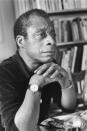
Stowe’s classic is not much read today. This is too bad. In recent times critics such as the brilliant novelist and essayist, James Baldwin, have asked new and probing questions of Uncle Tom’s Cabin. In Baldwin’s reading, the book is “a catalogue of violence . . .leav[ing] unanswered and unnoticed the only important question: what it was, after all, that moved her [Stowe’s] people to such deeds.” Stowe’s novel, sentimental and distant as it may seem to our ear today, can still speak to the country about slavery’s ugly offspring, racism. It is fitting that this book remains alive and vital, continues to be “cussed and discussed.”

Thursday, December 22, 2005

CROSSROADS COMMENT--Smoke Free Bars and Hockey Helmets


How long will Vigo County wait to establish laws banning smoking in public places, including all restaurants and bars? Will we be the last to limp onto this moving train?

Is it futile to review again the studies that support this action? The science is overwhelming. Let’s just say that if you work or regularly frequent a public establishment where smoking takes place be prepared to pay now and pay later. Pay now in cleaning bills and throat lozenges as you try to get the noxious fumes out of your threads and sinuses; pay later for inhalers, surgery and medications.

Everyone knows all this. Let’s add a different take to counter the mind set of bar owners and some public officials as they voice resistance to a health policy that is rational and socially conscious. I wasn’t smart enough to come up with this on my own. I’m using ideas from the book Micromotives and Macrobehavior. This is a work by the co-winner of this year’s Nobel Prize in economics, Thomas C. Schelling. And don’t let that title scare you away. The guy not only wins heavy medals, he can write.

Take a deep breath (if you’re a smoker, two short ones) and think about this.

You walk into a bar on Wabash Avenue. It’s the place to be. There are great murals by a local artist on the walls, the music is cooking, the crowd is hyped. But the air inside is chewable. It smells like King Kong’s ashtray after a night out with Fay Wray. Still, no one’s wearing a gas mask or one of those fancy Columbian kidnapper scarves across their faces. You might think everyone is oblivious to the free-floating carcinogens clouding the room. You notice, however, that there is more coughing than conversation going on.

Now it’s time to send in Nobel laureate Schelling to do his thing. First the “micromotives” part.

The Nobel man grabs a drink and picks his way through the crowd and the haze. He asks individuals how they feel about the lack of oxygen in this smoggy oasis. Many of the answers are a resigned, “No problem.” From the majority, who it should be noted are nonsmokers, there’s a self-consciously jaunty, “If they can stand it,” glancing around at the scattering of smokers, “so can I.” The wait staff and the bartenders glance anxiously over at their boss, they pretend to be too busy to respond to the Nobel man’s questions. The bar’s owner takes all of this in with a smug, just shy of obnoxious, “I told you so” look on her face.

According to Adam Smith’s famous invisible hand theory, customers mingling in Club Killer Fog make a decision and behave in the way they do because their choice to suffer a night of breathing toxic air gives them a reward–camaraderie, a chance to hear live music, the pleasures of seeing and being seen–outweighing other choices, say visiting a climate-controlled museum or any other non-smoking establishment. Adam Smith theorized that these individual market decisions add up to promoting the greatest good for all.

Taking note of all of this are Vigo County’s commissioners, Mason, Anderson and Bryan. They sit at the end of the bar, listening and taking notes, or at least two of them do. The Vigo County Health Commissioner, Dr. Enrico Garcia, makes a brief appearance. He sticks his head through the door and quickly retreats, gasping for breath. City Councilman Cummins, wearing a T-shirt proclaiming “Who Says No Man Is An Island?” sits alone, his back to the wall. He’s at a table playing solitaire.

But Schelling’s not through yet. Here comes the “macrobehavior” part.

Somehow, perhaps by jumping up on the bandstand, swinging his Nobel medal in a circle around his head, and rapping out a chorus of, “You’re Talkin’ Fine But It’s Macro-B Time,” Schelling manages to get everyone in the place to respond to a secret ballot on how they would feel about flipping this public watering hole into a non-smoking orbit. Following the lead of entire nations, states and a vast number of cities, they, smokers along with non-smokers, vote overwhelmingly in favor of a smoke-free environment.

So what’s happening here? And this is the part that helps win Nobel Prizes.

Through closely reasoned studies Schelling demonstrates that the individual pursuit of self-interest does not always reflect the common good. A famous example he cites is about hockey players and helmets. For many decades players in the National Hockey League did not wear helmets. Vanity, an edge in peripheral vision, and many other possibilities can explain this dangerous individual choice. Injuries were frequent and severe. In 1969 one player had this to say about wearing or not wearing a helmet: “It’s foolish not to wear a helmet. But I don’t–because the other guys don’t . . . But if the league made us do it, though, we’d all wear them and nobody would mind.” A number of secret polls among players confirmed this observation. In 1979 the National Hockey League instituted Helmet Rule 22.

OK. That’s a long way to go in order to underline the obvious–second hand smoke is very bad for your health. It’s wrong and should be illegal to expose people to this smoke in facilities that serve the public.

Local government officials should step up and do their duty. They should take action to protect the public’s health. I drag Schelling in to support them when someone comes up to one of these officials, drops an ash on their toe, and claims this smoking v. smoke-free business is about property, that it should be an individual decision. That that’s the only way, the “American way.”

When Mason, Anderson and Bryan hear this emotional non-argument, their response should be: No, the right way, the truly American way, is to protect the people of the community from individuals and business operations that do harm to the health of the community. And, they might add, that “individual decision” stuff in this case is about as worthless as a cigarette butt in a wet gutter. Haven’t you read Thomas Schelling’s “Micromotives and Macrobehavior”?

Tuesday, December 20, 2005

The Mystery of the Missing Readers

[gary daily col. 27 July 28, 2002]

“Self-knowledge always requires conversation.” - Martha Nussbaum

Two discussions of David Guterson’s Snow Falling on Cedars (the “If All of Vigo County Read the Same Book” selection) took place this past week. The discussions were held on Monday, July 22, at Boo’s Crossroads Deli and on Tuesday, July 23, at Coffee Grounds. Local businesses (and I would be amiss if I didn’t add Harry and Bud’s and Java Haute here) that have provided space and promoted these discussions are to be congratulated, thanked, and supported for their civic and book-minded consciousness.

At a time when the business culture of America is taking deserved lumps for its clumsy venality, these local entrepreneurs acknowledge that reading and discussing good books creates intangible benefits that cannot be quantified by any accounting practice. It would be great to hear about discussions of the “If All” book being held during lunch and coffee breaks in work settings around town. If such a discussion is planned or has been held where you work, please let me hear about it.

Some disappointment accompanies these feelings of pride. Chris Schellenberg of the Vigo County Public Library Community Services Department passed along the depressing news that no one showed up for one of the last discussions she held. Readers who have not participated in a discussion should certainly make an effort to attend a future discussion. Those of you have attended a discussion might consider attending others in the future. Different groups of readers always give rise to new ways of thinking about what was once fast and settled in our minds.

And isn’t it strange that people in general and, ah yes, men in particular, do not read more books? (Sales reports indicate that women purchase close to 70% of the books sold in this country each year. And women also make up the vast majority of book club members.) “Profits” accruing from reading good books do not require Arthur Anderson accounting sleight of hand. So why not read and discuss demanding books--books that furrow the brow and make you think, books that entertain in simple and complex ways, books that focus creative anger, and books that make you feel like you’ve accomplished something very important? Missing readers are a mystery.

Mystery yes, but explanations do come to mind. An idea I am presently toying with isn’t very flattering, probably not fair, and certainly not conclusive. But we are four months into “If All of Vigo County Read the Same Book” and there is strong evidence that this wondrous, life and community enhancing program is behind schedule. It's worth delving into the mystery of the missing readers because they are so pervasive in our aliterate culture. You probably have ideas on this question. Wish you would pass these along to me.

In “The New Yorker” a few weeks back, Malcolm Gladwell published an essay on corporate America with the intriguing title, “The Talent Myth: Are smart people overrated?” Gladwell ends up thinking they are. He runs down the evidence of companies becoming blindly obsessed with a “talent mind-set” approach to hiring and compensation. At this point he couples this errant “star” system with the work of Carol Dweck, a Columbia University psychologist. She finds that on Wabash Avenue and Seventh Street, and across the land, people believe that intelligence comes in one of two flavors: it’s either a fixed trait or it’s malleable.

Then Gladwell notes the significance of the linkage: “the way we conceive of our attainments helps determine how we behave.” More specifically, the stars of the corporate world, those who sally forth on the hobby horse of “fixed intelligence,” those who hold the view that “talent” is innate, complete, and unshakeable--these "Fixed" types have serious difficulties with circumstances threatening to their self-image. (I might add the observation that a whole Workshop/Seminar industry has sprung up aimed at slipping a little empathic bend into the "Fixed" souls of the world.)

Wrenching all of this out of context and shifting to the murky mystery of the missing readers, I’m ready to propose that aliterates, those who own the skill of reading but choose not to use it, are of the opinion that intelligence is fixed.

Fixed intelligence types range from presidents of large countries to those who are academic superstars in their own minds, they can also be found working as insecure underlings holding down entry-level positions. Status achieved and amounts of power held is inconsequential. Behavior tells the tale. Wherever the believer in fixed intelligence is found, he or she is very careful to steer clear of anything that might indicate their fixed views and visions are deficient, flawed or incomplete. Personal encounters with intellectual dissonance have the pain producing potential of messing with their smooth world of assurance.

Reading and discussing challenging books can reveal intellectual weaknesses and blind spots to the self and to others. “Malleables” welcome this and call it growth; the “Fixed” view types ignore and deride reading books that are not a part of their narrowly defined fields of expertise and skills. As psychologist Carol Dweck puts it, those with a fixed view of intelligence “care so much about looking smart that they act dumb.” Hollow comfort trumps the benefits of new challenges.

Ouch! How’s that for a bald and baldly delivered judgmental analysis of a certain strain of aliterates? But how would you explain the unwillingness of aliterates to change their bookless ways?

Jackasses Loose in the Land of Opir

[gary daily col. 26 July 21, 2002]

“Corporation, n. An ingenious device for obtaining individual profit without individual responsibility.” -Ambrose Bierce

Does Enron’s and Haliburton’s energy shenanigans match or exceed Tea Pot Dome in the 1920s? Is it time to reissue Louis D. Brandeis’s Other People’s Money (1910), a classic book of informed muckraking journalism that called avaricious banks and insurance companies to task? Will tomorrow’s personal finance headlines shout: “Bernie Ebbers, the Robber Barons and Your 401(K)”? Is President Bush going to end up in the history books standing next to a cartoon image of an oil derrick embracing “W” while pumping money from sweetheart loans into his pockets?

Editorialists and political commentators are thrashing about searching for examples from the past that parallel or provide insight into the scandals, corruption, and manias wracking our economy today. Unfortunately, the history of our economy is regularly punctuated with corresponding circumstances.

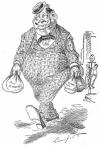
It’s possible these references will miss the mark with the historically challenged. Take the example of “W” and the money pumping oil derrick. How many people know that Bush’s closest advisor, Karl Rove, has a favorite past president, William McKinley? Or, more to the point, that in McKinley’s day political cartoonists often depicted him standing next to a robust fellow with dollar signs covering his chest and stomach? This was “Dollar” Mark Hanna, the big donor bag man behind McKinley and the Republican Party in 1900.

One would suspect that Rove’s first job at the White House was removing all pictures and other evidence that Theodore Roosevelt ever came near the oval office. It was McKinley’s successor, the Republican Roosevelt, who railed against and regulated what he called the “malefactors of great wealth.”

But money movers and securities shakers need people to move and shake. That’s where the proverbial “little guy” comes in, sometimes by choice sometimes not. Examples of trying to jump on the gravy train and ending up with grease spots all over your financial statements go way back.

Though sometimes mentioned in the business press and used as a source for Louis Rukeyser type humor, I would guess that Charles McKay’s book, Extraordinary Popular Delusions and the Madness of Crowds (1852) is rarely read today. It details some of the many occurrences in history of mob psychology, financial and otherwise. For our purposes, the chapter on the South-Sea Bubble in early eighteenth century England is particularly relevant for our times. The recent dot-com fiasco has nothing on the bubble schemes of this era.

As McKay tells it, hard-working Englishmen, along with the always numerous “I’m smarter than you” types, threw money at proposals tenuously tied to a treaty giving the British a monopoly in trade with Latin America. Before it was over fortunes large and small were depleted. Schemes attracting investors included the importation of Spanish jackasses to improve the stock of mules. There was also something described as a company “to discover the land of Opir and monopolize its gold and silver.” I guess this passed for what current day stock analysts call a “story stock.”

During our current troubled times of “War on Terrorism” and the ascendancy of the National Rifle Association, my creepy favorite from this earlier era of Bubble companies was the proposed manufacture of a firearm which could discriminate among its targets. This gun would have the capability of launching square bullets at infidels (and the expanding British empire had a lot of these to deal with) and round bullets at Christians. Perhaps armed airline pilots today could be fitted with a similar model, one that could distinguish between First Class and Economy Class passengers.

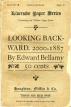
A final example editorialists might draw on is Edward Bellamy’s Looking Backward: 2000-1887 (1888). This book was a phemomenal best seller and much better known than McKay’s work. It examines the origins and workings of a utopian society in the year 2000 from the point of view of a time traveler who has arrived there from the year 1887.

I remember two striking things about “Looking Backward.” Bellamy rejects the “invisible hand” of the market place. His vision rejects random acts of selfishness and embraces an optimistic and highly rationalistic view of how life might be ordered. As explained to the time traveler, the utopia he finds himself in all came into existence because the true and noble nature of human beings was allowed to evolve free of the greed and grasping of capitalistic competition. You don’t have to look very far to notice that Bellamy’s hopes for the future ended, for better or worse, far wide of the mark on that one.

The other thing I remembered was Bellamy predicting the coming of the marketing behemoth of the western world, Wal-Mart. Here’s the prescient passage: “The great city bazaar crushed its country rivals with branch stores, . . . absorbed its smaller rivals till the business of a whole quarter was concentrated under one roof, with a hundred former proprietors of shops serving as clerks.” Wal-Mart execs are perplexed, they're not sure if they should sell this book or try to outsource it to a desert trench in western China.

So look for Brandeis, McKay, and Bellamy to come up in editorials, Op Ed pieces, and even in TV news commentaries. I wonder if “W” knows about any of this history or these books? Karl Rove does, but he’s not telling.

Saturday, December 17, 2005

The “Nobody Is Us” Memoir


[gary daily col. 25 July 14, 2002]

I'm Nobody! Who are you?
Are you--Nobody--too?

--Emily Dickinson

St. Augustine and Sammy Davis, Jr., Ulysses S. Grant and Ann Heche, they all sat down and decided history and the world deserved to have their life stories at hand. The personal narratives of the powerful, the rich, and the celebrated have always been a magnet for readers. Some serve us well while others are as edifying as The Jerry Springer Show.

But what do you make of memoirs of “nobodies”? Frank McCourt and Mary Karr kicked off this spike in the market for books emphasizing the gritty details of lives not yet famous. And the list grows monthly. I’ll label these the “Nobody Is Us” memoir. What’s this all about? Who can be certain, but even the casual reader of this fare can spot some common themes explaining the interest and readership they garner.

“As the twig is bent the tree’s inclined,” goes the old saw. The truth of this bit of folk wisdom is radically ratcheted up in these books. Childhood is remembered as one part dark family life and one part cloudy landscape. Mom and Pop turn out to be the damaged clones of “Martha” and “George” freshly escaped from Albee’s “Who’s Afraid of Virginia Woolf.” And the home turf is about as far from Mr. Rogers' neighborhood as you can get. Whether living hard in a slum or a trailer park, living light in a comatose suburb, or living fat in a glitzy urban high rise, the child’s community always carries the zip code of a circle from Dante’s “Inferno.”

Here, in the green turned gray childhood years, twigs are not so much “bent” by heredity and environment as they are psychologically and sociologically gouged and bruised. These scars on the memory remain prominent, displayed in disfigured growth rings far into the future.

Next up, it’s welcome to adolescence. These are the years no responsible “Nobody Is Us” memoirist can ignore or quietly pass over. How could they? Barring participation in one of the recurring wars obligingly created by our leaders, what else represents a “peak experience” in young lives? Starting at age thirteen (twelve, if MTV was available to them), teens storm about in a haze of hormones, idealism, need, and loneliness. This is the stuff that sells books. Readers become nostalgic voyeurs to the memoir’s nostalgic exhibitionism.

“Nobody Is Us” memoirs catch the wave of adolescence and work it into a frantic frothing frenzy. Who is not familiar with the angst-ridden and pimple-faced teenager negotiating the unfairness, ambiguous fullness, and confusions of life? Needless to say they are severely overmatched. The manic-depressive elements of what constitutes the “youth culture” of the day are explored in sweaty detail. If the driver’s license was obtained in the fifties up into the mid-sixties, we read of “first time” carnal initiations, alcoholic adventures, and what was hip and meaningful in the pop music of the moment. The late sixties to early eighties (Yes, twenty-somethings are writing their memoirs!) are more direct, it’s sex, drugs, and rock’n’roll time, baby!

These not-quite-coming-of-age life dramas resonate with readers. They depict a period in lives profoundly and indelibly, if not always accurately, inscribed in memory. When we tune the radio to a station with a “Classics” format, we are involuntarily transported back into those years. A singer or song recalls the exquisite and the excruciating with perfect emotional pitch. That’s our music we say; it’s the soundtrack to our lives.

When relating the span in life from 25 to 45 (recognizing that every generation has its late-bloomers, its delayed conversions), these memoirs reach for redemption. The scourges of childhood are healed and the sins of adolescence are cleansed.

But there are always final hurdles to be vaulted. Here we may meet the baggage of bad marriages and worse divorces, a searching for love in all the wrong places, the failure to find satisfying work or ditch work that does not satisfy, the requirement of dealing with friendships lost, betrayed, and thinned out. In the most didactic of these memoirs, this is all “necessary work” if one is to be “happy” or “secure” or “complete” or to finally “love oneself.”

It’s a satisfying miracle to most readers when the “Nobody Is Us” memoir ends on one of these notes of “transformation.” As William Dean Howells put it many years before Hollywood cast it in celluloid concrete, “what the American public always wants is a tragedy with a happy ending.” Lives fated for ruin, ignominy and worse manage to right themselves through love, religion, or rehab. Surprisingly, luck and pluck, the good old nineteenth century deus ex machina, are only rarely called forth to clear away the psychological/historical underbrush hiding the yellow brick road to serenity and self-actualization.

Often floundering on sensational anecdote, or pushed along by strained coincidence, these memoirs can read like the script of a spiritless infomercial. And while it may be true that “everyone has a story to tell,” claims of authenticity cannot substitute for artful prose. But when they do succeed, when readers take away understanding not lessons, the personal memoir can be about more than Nobody, even about more than Us.

Ghost of Thomas Bowdler Walks the Land

[gary daily col. 24 July 7, 2002]
A May Gallup Poll showed that 71% of Americans still believe in hell but preachers are increasingly reluctant to preach about it. Some say hell is just too negative.
--Wall Street Journal, June 21, 2002

And still the ghost of Thomas Bowdler walks the land--scalpel in hand, scissors nearby, meat axe at the ready should the butchering require action of a more gross and dramatic nature.

In 1759, Bowdler was five years old when one Reverend Francis Gastrell decided a certain mulberry tree was blocking his view of the horizon, or was it his personal vision of heaven’s gate? He strenuously applied the blade of an axe to it. It turns out this tree was believed to have been planted by William Shakespeare, Stratford, England’s, favorite son. (And what did Reverend Gastrell know and when did he know it?)

I personally believe the legend that has Gastrell keening into the wind, “I’ll be back!” as he was “escorted” out of town by devotees of the Bard. And I assign credence to the story that a never-to-be-a-boy named Thomas was nearby as the good Reverend laid his axe on this famous fruited tree, and that he stood weepy and stern-faced by the side of the road as Gastrell took his leave.

As it turns out little Tommy Bowdler took up the profession of medicine. But ministering to the boils of the body did not satisfy his desire to do harsh good in the world. Purification--body, mind and soul--became his watchword and duty. This mission was first displayed in his concern for unsanitary conditions in various wine and cheese watering holes dotting the coast of France. He reported these conditions with relish and in some detail to what we can only guess was a grateful English public. The record is thin on how the level of English traffic to these quaint French inns was affected by his research.

Dr. Bowdler’s most ambitious foray into the purification business, however, was literary not sanitary. Sustained by the unfailing engine of unflawed righteousness, Bowdler took on the gargantuan task of cleansing the plays of William Shakespeare. Bowdler, being a modest but determined soul, always declared that he added nothing to the Bard’s works. Excision was the service he provided readers. As he put it, only “words and expressions are omitted which cannot with propriety be read aloud in a family." His inspired eraser created the Family Values version of the plays in 1818. This ten-volume work was commercially successful and aptly named, “The Family Shakespere.”

Drawing on reserves of energy limited to those who carry Truth in their hip pocket, Bowdler went on to cleanse Edward Gibbon’s The Decline and Fall of the Roman Empire. By his report, this task involved, "the careful omission of all passages of an irreligious or immoral tendency." I have not been able to find Bowdler’s own words on his modus operandi for one of his last projects, a purified version of the Old Testament of the Bible. You might take a look for yourself and guess which mulberry trees in that book Bowdler trimmed or removed.

Bowdler’s labors, as with similar exercises since, were momentarily popular successes but abject failures with critics, scholars, and serious readers then and now. His efforts, however, did insure a place for him in our vocabulary-he is now an eponym, a word based on a proper name. To “bowdlerize” in my dictionary is: “1. To remove or modify the parts (of a book, for example) considered offensive. 2. To modify, as by shortening, simplifying, or distorting in style or content. Given the chance, Shakespeare, Gibbon and the priests and prophets of the Old Testament might add to this definition.

Nevertheless, bowdlerize is a handy term to have within reach. Recent revelations in regard to the New York State Regents English exams presents us with a case, in these test crazed days, worth pondering. While going about their work the so sensitive test-makers rounded up the usual suspects--references to race, religion, ethnicity, sex, nudity, alcohol and modest profanity. In proceeding to bowdlerize creative and original sources, they left the very ingredients that helped to make these writer's works "original" on the cutting room floor.

Two examples of their work: Students were asked to write essays on doctored passages from renowned writers such as Anton Chekhov and Annie Dillard. In a Chekhov passage, a crucial section in the original dealing with a 19th century style strip-search of servants was omitted. Dillard’s story, “An American Childhood,” is turned into meaningless mush due to excisions. Her memoir tells of regular trips to a library in the black section of town where she learns early and important lessons about race and racism in America. All racial references in the Dillard work were inexplicably eliminated.

I am happy to report that in this case the ghost of Thomas Bowdler has been exorcized. Earlier this month the New York Times reported that the test making honchos in New York State had “announced [that] literary passages in state-administered tests would no longer be altered to delete unwanted words or phrases.”

But why is it I keep hearing a self-righteous, threatening whine: “I’ll be back!”

Scholarship Ain't Hip-Hop Sampling


[gary daily col. 23 June 30, 2002]

The footnote would seem to be the smallest detail in a work of history. Yet it carries a large burden of responsibility, testifying to the validity of the work, the integrity (and the humility) of the historian, and to the dignity of the discipline.
--Gertrude Himmelfarb

If you’re paying attention, you know the lowly footnote has been batted about in the press this past year in relation to the professional indiscretions, viz. plagiarism, of the popular historians, Stephen Ambrose and Doris Kearns Goodwin.

You do remember footnotes, don’t you? These nicely numbered lines of information come in two varieties. Basic source notes start with the names of authors or editors. What follows always includes italicized book and journal titles and publication data. This all may bristle with the barbwire of abbreviations in Latin and English. That “viz.” (it's Latin for namely) I hit you with in the first sentence being one example of the species.

Content or explanatory notes consist of the author stepping aside from the text and imparting information of a diverting nature. For example, Anthony Grafton reports in The Footnote: A Curious History that Edward Gibbon used one of his 383 footnotes in The Decline and Fall of the Roman Empire to make fun of the too-literal theologian who castrated himself after reading the injunction to "disarm the tempter." That Gibbon, what a sense of humor.

Notes of this kind are about authors knowing more about the subject than they feel they can fit into their main text. Grafton, an unabashed champion of the footnote, insists all the good stuff is in explanatory notes. He calls footnotes "anthills, swarming with constructive and combative activity." Grafton tracks down the first such note to Pierre Bayle, author of the Historical and Critical Dictionary (1696).

Still, many readers ask what good are they? They fill up space, distract the eye, interrupt the flow of the text. And besides, you may say, I know the person writing this book I’m reading is smarter than I am. Duh! That’s why I’m reading this book. Why rub my nose in all of this academic apparatus?

But not so fast. Here’s William H. McNeill, the distinguished University of Chicago historian on source notes.

“Citation of the source of a quote or idea or piece of information is surely the central role for responsible footnoting. And citing one's sources accurately is not a trivial matter. It holds erratic personal memory in check and acknowledges debts, while incidentally also establishing a scholar's claim to participate in a given universe of discourse.” In other words, This ain't Hip Hop sampling pre-1991, Jack.

Footnotes may not be engrossing to most readers, and they may not be appropriate in works of a general nature, or in books with no intention of contributing new information, ideas, or adding to an ongoing “universe of discourse.” However, the choice to cite sources, to use footnotes in a book, carries with it the responsibility to fulfill the letter and the spirit of McNeill’s views on footnoting. And this brings us back to Ambrose and Goodwin.

There is little use in rehashing the details of the Ambrose and Goodwin cases. They operated outside of the standards of scholarly procedure. They “borrowed” the words and research of others and, again in McNeill’s words, failed, “[to] hold(s) erratic personal memory in check and acknowledge(s) debts.” Both have admitted to this and they and their publishers have taken steps of a personal and monetary nature in restitution for these professional failings.

Given these disclosures and reactions, you would think these cases would be, not forgotten, but at least behind us. Unfortunately we now have David Gergen’s recent mewing defense of Stephen Ambrose and Doris Kearns Goodwin. His “U.S. News & World Report” editorial of June 10, 2002, desperately seeks to excuse these two. This is a disservice to the reading public.

Sure, Gergen says, “both Ambrose and Goodwin were wrong, but their mistakes were inadvertent, born of haste, not intention.” He follows this non-defense defense up with comments lovers of history would not dispute. He nails Americans as an historically illiterate bunch. His notion that there is a great need for epic stories of the past that are engaging, accessible, and “entrancing” is unassailable. But is Gergen really saying that such history, history written with style and verve, cannot adhere to the long established practices of solid scholarship? I hope not.

Gergen’s argument is surprising and disappointing. He is someone you would expect to see leading the charge for “standards” and unadulterated scholarship. It would be a good idea for Gergen to check in with fellow conservative and historian, Gertrude Himmelfarb, before he pronounces on this subject again.

Sunday, December 11, 2005

CROSSROADS COMMENT--"Reading at Risk" NEA Survey Is DOA

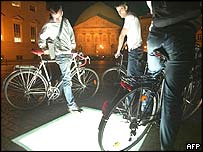
In 1933, Nazi’s piled books in a street in Berlin and set them on fire. Near that spot today is a memorial, a plaque and a window at ground level. Look down through the window and you will see a space lined with empty bookshelves.

Is it time to start building memorials in front of the schools and libraries of the nation similar to the burned books memorial in Berlin? If we did, peering through their plexiglass windows you would see well-stocked shelves of books on the edges of the cave space. But flickering light from highly polished television and computer monitors in the center of the space would reveal that the books on the shelves are covered in dust, unread.

Reading at Risk: A Survey of Literary Reading in America” is the title of a National Endowment for the Arts (NEA) report issued July 2004. Among the conclusions in the report: “‘Reading at Risk’ is testimony that a cultural heritage is disappearing, especially among younger people [18-24].” Another finding: “The percentage of U. S. adults reading literature dropped from 56.4 percent in 1982 to 46.7 percent in 2002 . . . . ” “Reading is Routed” would better fit the significance of what is smothered in this timid report.

Timidity is infectious. What was the response in the public square when the storm flag of Risk was sent up the NEA’s very short flagpole?

There was an uninspired flurry of commentary, but nothing smelling of serious concern. From a few professional literary critics I read or heard, there was smug tsk, tsking of the “There always have been readers and non-readers and there always will be” variety. National Public Radio did a standard five minute summary and commentary. There were short mentions in a few of the newspapers I read.

The television news-entertainment shows did what television news-entertainment shows do best, they devoted thirty breathless seconds to the report. Ads for the latest over-the-counter wonder drugs “you should ask your doctor about” followed. Time devoted to the NEA "Risk" report was equal to what it takes to read a haiku poem; time allotted to the commercial was what it takes to read (though not comprehend or appreciate) a Shakespeare sonnet.

TV producers wouldn’t argue over this allocation of air time. Shakespeare’s genius may serve as a home remedy antidote for attention deficit disorder, but what did the Bard ever do for acid reflux or the botttom line? And no visuals!

But wait, it turns out that there are visuals. Open “Reading at Risk: A Survey . . . ” and you find page after page of charts and tables. By my count, forty-three tables and charts stomp around in the forty-seven pages of the report. Boxed graphics rise out of the text like a herd of pachyderms escaped from the circus. They’re a leathery species, all dusty and glaring. Like the readers of this survey, they are prone to wandering about in search of stimulating nourishment.

Please recall, the report is titled “Reading at Risk.” Most readers will feel very much at risk when they run across the strands of argument and fact tied to “Multiple Logistic Regressions” and “Correlation Analysis of Predictor Variables.” I guess the assumption here is that when a nation’s print culture is disappearing it’s time to put on our sleeve garters and green eye shade and get down to business. I grant that if you wrinkle your brow and stay with this report long enough you will conclude, yeah, looks like “Risk” to me.

Unfortunately, those clicking sounds you hear in the prose of this report are not ideas and facts making urgent connections. No, just computer keys tapping out another finely calibrated, bloodless calculation. Even dedicated supporters of reading will push this study aside, put off by its bland worship of statistical methodology and the resulting narrowing literalism. Needless to say, should aliterates randomly access “Reading at Risk” they will be reaching for their Game Boys, cell phones, and iPods faster than you can say “multicollinearity.”

Shouldn’t Risk be delivered with at least a modicum of pizazz? I’m not saying give us stand-up comedian bits or cliff-hanger coyness. But asking that a report on literary reading be written in prose, in an arresting prose style, doesn’t seem an excessive request.

Why was the job of awakening the public to the collapse of a heritage, the imminent dissolving of a habit of mind, the fast fading of a source of solace and fancy in our lives turned over to Barteleby the Scrivener’s compliant colleagues? Why was it assumed that the only kind of “hard” evidence worth placing before the public consists of numbers banked up, ranked into neat columns, filling pages like so many digital tombstones?

There was a time when poets, novelists and essayists at least helped to serve as our guides in matters of concern and feeling. Does anyone at the NEA remember when the crafted subtleties of language on the page guided understanding and motivation? Literary reading helps carry thought to reasoned conclusions, opens the imagination to the wondrous strange, and lifts the spirit to fanciful and deliciously dangerous heights. “Reading at Risk” does little in the way of carrying, opening or lifting anything.

Poets, Wordsworth’s unacknowledged legislators of the world, can do better than this. One poet in particular should do better, and soon.

Dana Gioia, the Director of the NEA, is a wonderful poet. The man can write. In the Preface to the report he says: “print culture affords irreplaceable forms of focused attention and contemplation that make complex communications and insights possible. To lose such intellectual capability–and the many sorts of human continuity it allows–would constitute a vast cultural impoverishment.” Please note: Not a single multiple logistic regression formula was required to cast the shadow of the grave truths in these words.

Mr. Gioia’s NEA should be at work right now on a companion volume to “Reading at Risk: A Survey . . . .” We need something like “The Risks of Not Reading,” and it needs to be written with the conviction and heat literary artists bring to their craft.

Too Many Words


[gary daily col. 22 June 23, 2005]

“It is said that people are not as readily deceived by window display, but we all know better than this.”

-L. Frank Baum, author of The Wonderful Wizard of Oz and founder of The National Association of Window Trimmers

Have you been to Philadelphia lately? It seems the “Cradle of Liberty,” home to historic structures such as Benjamin Franklin’s House, Carpenter’s Hall, the Second Bank of the United States, and the holiest of holies when it comes to Revolutionary era sites, Independence Hall, are going high tech. This “high tech” catch-phrase can mean anything from credit card enabled soft drink machines that work to Bush supported Star Wars systems that don’t. In this case, however, we’re talking about adding entertainment value to experiencing history by putting into place (use your best Ed Sullivan voice here) the really big “Lights of Liberty” show.

I haven’t personally experienced “Lights of Liberty,” though I have read a good deal about the American Revolution and the place of Philadelphia in the Revolution. Should I assume that listening to “MP-3 audio” of actors playing characters from the revolutionary period on headphones while, according to a New York Times report, “56 computerized projectors splash historical scenes on the facades of the buildings” would add a great deal to my understanding and appreciation of the Spirit of ‘76? Gosh, it sounds as good as a TV program. Only bigger.

It’s difficult to deny the reality of technology’s role in turning us into a visual, flash and splash oriented culture. This invariably pushes us away from a reading and thinking about words culture. We mistakenly, or lazily, believe that to see it is to experience it and to see it and hear it is to really know it. That “it” can range from the landforms along the Colorado River to the iconoclastic content of Rolling Stone magazine. As T-shirts and bumper stickers (almost) proclaim, “It Happens.” And “’it” happens in the neighborhood of the Liberty Bell and, even more distressingly, in local libraries.

I once paid a half-drunk entrepreneur in Moab, Utah, a saw-buck to take myself and a covey of flat-lander rubes on his smelly boat one night to see the “Lights on the Canyon” show. Does shining powerful floodlights on the rock formations along the Colorado River bank qualify as “high tech”? The next day I hiked up into those canyons, an experience which required some work and some sweat. I’ve told many people about that hike, you’re some of the few who have heard about my “Lights on the Canyon” fiasco. The ticket I bought to view those low tech created shadows is a heavy personal embarrassment today.

Moving from the silly trying to be sublime to the significant about to turn silly, it's reported that Rolling Stone magazine is in deep trouble. It seems this publication is suffering print journalism’s increasingly fatal malady, too many words. Long articles featuring the acclaimed (you choose) radical-activist-guerilla-new journalism-cutting edge-investigative reporting by people like Tom Wolfe and Hunter Thompson once made this magazine the must-read source of the “youth culture.” The latest edition of this audience now gets its news from joke TV news parodies and has traded ideology for attitude by making Eminem its guru of the season.

Poor out-of-step Rolling Stone. Cut loose by a generation lacking the powers of concentration once found among drug-addled fans of “The Doors” and “The Grateful Dead.” What to do? Here’s one take from an advertising executive: "It seems when people are trying to develop media vehicles for young people, they are going for the shorter attention span. I don't think there is anything inherently wrong with that. I just hope that Rolling Stone keeps its heritage of being the source of great reporting on youth culture."

Uh, huh. Sure.

I look for Rolling Stone to go the way of People, US, and MAXIM. It will be filled with photos, charts, thumbnail bios, and . . . more photos--abandoning the need for people to actually read anything more than the captions under photos. When America’s youth says, “Get real!” increasingly they mean show me the pictures, slip me the pirated DVD, visit this chat room, and don’t ever tell me, “You’ve got to read this.”

If this aversion to the word on the page was limited to “entertainments” who would complain? After all, we’re Americans. We work hard and we play hard, so why read? But libraries, which once were the guardians and champions of the world of books, are increasingly being turned into video stores, media palaces, and attention deficit dens for the digitally minded. Book and journal budgets in public and university libraries are being cut or put on hold in order to pay for the high tech installations of computers, servers, software, printers, etc. and the uncounted support costs that invariably accompany such structural changes in mission.

None of this, however much money is spent wisely or wastefully, can ever replace or be a substitute for books. The vast and comfortable and demanding world of print can never be digitized out of existence. With the exception of the three people who believe Wired magazine ranks with the Bible, the Koran, and the lost commentaries on Zoroaster, who steps forward to say the future is a world of pixels and the age of print has passed?

And I’m still looking for a person who has, by uncoerced choice, read an entire book on a computer screen. The human experience of reading deeply can never take place through “interfacing” with a piece of glass any more than the history of liberty, the wonders the Colorado River landscape, or even a thoughtful Rolling Stone essay on Hip Hop culture can ever be translated into a high tech type light show.

Saturday, December 10, 2005

Ben's Advice: "Kill no more pigeons than you can eat."

[gary daily col. 21 June 16, 2002]

When asked, What man is most deserving of pity? Benjamin Franklin answered, “A lonesome man on a rainy day who does not know how to read.”


Benjamin Franklin will soon be coming at us from all directions-- biographies of his life, anthologies of his writings, and most particularly the sayings from his “Poor Richard’s Almanac.” This essential American was a printer, inventor, scientist, diplomat, and, we should never forget, a very successful businessman. Successful enough in the demanding world of colonial commerce to retire at forty and spend the next one-half of his life engaged in scientific and public pursuits.

He was born in 1706. Do the math. In just three years we will be on the cusp of Franklin’s tri-centennial and there is nothing like 100-year chunks of time to oil the curiosity of biographers and grease the gears of the publishing commerce machine. Added to the torrents of print washing over us, there will be memorabilia ranging from tea towels to T-shirts. Cable television docu-dramas will reveal his French dalliances and PBS is certain to mount four to ten hours of film well-laced with learned commentary. And, need I say it?--there will be web pages.

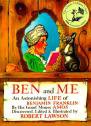
It will all be wonderful because Franklin was so wonderful. I know this because in fourth grade I read Ben and Me, the story of Benjamin Franklin from the perspective of a mouse that lived in his tricorne hat.

But, as they say on the street, Franklin’s “The Man.” That’s not on Wall Street in the east or Rodeo Street (OK, Drive) in the west, but on Main Street. And how could he not be. Anyone can pick up Franklin’s 18th century maxims and find what needs to be said about life, society, and making a living. Try applying Franklin’s sharp and memorable words to the recent history of the U. S. of A. and you’ll see what I mean.

Take the yuppies of the late ‘70's. Ben has them to rights with his: "It is hard for an empty bag to stand upright." Or, if you’re in a more charitable mood (meaning you came of age in the 1970s) the following might better fit and assuage your soul for the sins of disco: "At twenty years of age, the will reigns; at thirty, the wit; and at forty, the judgment."

And you can pin down the rationalizing of the “Gordon Gecko” “Greed is good!” crowd of the ‘80s with: "God helps them that help themselves." It is more than likely that Franklin, always the practical moralist, would have counseled the fictitious Gecko along with the very real Boskey, Millken and the boys in the back room to: "Kill no more pigeons than you can eat." Nah! They wouldn’t listen. They still don’t.

With the boom and bust of the 1990's the choices from Franklin’s “Poor Richard” are without end. For example there’s, "Experience keeps a dear school, but fools will learn in no other." And for the hoopla surrounding the hollow dot-com companies and the ill-fated investors who had the temerity to invest in shares of something actually (and how Franklin would have enjoyed this) called “story stocks,” we have: "Well done is better than well said."

We are just into the first decade of the 21st century, but with Enron, Arthur Anderson, Tyco and who knows who’s next, it’s not too early to peg at least part of this fresh century on his observation that: "They that will not be counseled, cannot be helped. If you do not hear reason she will rap you on the knuckles." We can at least hope for “reason” and some “knuckle rapping,” can’t we? But don’t hope for too long, because as “Poor Richard” puts it: "He that lives upon hope will die fasting." And of course Ben “The Man” couldn’t be “The Man” without taking a swipe at the scapegoat profession of the ages: "A countryman between two lawyers is like a fish between two cats."

Personally, I will always go with Franklin’s, "Dost thou love life? Then do not squander time, for that's the stuff life is made of." I say this not because I have taken these words to heart, filled soul and sinew with their imperative, and turned living into that lobotomizing “24/7" materialistic limbo so much in vogue today. My fondness for this bit of wisdom is tied to a favorite seventh grade teacher who found an occasion to peal forth with “do not squander time, for that's the stuff life is made of” at least once a week. The other thing she thought “life is made of” was diagramming sentences. Demonstrating again that Franklin’s wisdom can be put to as many uses as there are Franklin readers.

Details--Vermin As History

[gary daily col. 20 June 9, 2002]

“Nothing capable of being memorized is history.”
-R. G. Collingwood

It’s a broad generalization, but a fair one: readers of history have a strong tendency to trust historians on details while holding interpretive analyses of the past at arms length. This tendency is in line with the national game of trivial pursuit called “surfing the net.” There is a passion for quick and easy factual information and a rushed avoidance of nuanced comprehension.

This schizoid-like reading and non-reading of history (defining history as a written account of the past) is probably due to how history is most often used by people today. There is much solemn nonsense stated in the public sphere about “history repeating itself” and “learning the lessons of the past,” but let’s pass along the word that rather than “searching for a usable past” the most common “use” of history is to settle something akin to bar bets. The variations this takes can’t be counted, but the form is recognizable to all.

“Do you know the name of Alexander the Great’s horse?”

“Traveller.”

“No, that was Robert E. Lee’s. I think Alexander’s was Bucephalus.”

“No. You’re putting me on.”

“Yeah, it was. Bucephalus.”

“Look it up.”

At this point the thickest unread book on the shelf is taken down and the index scanned. Or, in an increasingly likely scenario, this “historical discussion” is ended by putting trust in the pixilated pedantry of Jeeves, as in “Ask Jeeves,” the online search engine.

Historians, it needs to be repeated, do not comb musty documents to settle arguments and thrill antiquarians. The facts they mine in archives are witnesses they cross-examine. They attempt to better understand the past by using their evidence to answer the questions they pose about the people and events of the past. It is the rare historian who would hold that the facts speak for themselves.

People I talk to tell me: “I just couldn’t get into history in school. All those names, dates, and events. But I love history, now.”

I take this as a sincere and honest statement, regardless of the tone in which it is offered.

But it’s discouraging that general readers of history, and travelers to historical museums and sites, and even (some? most?) historical re-enactors “love” history in their maturity for the same reasons they found it intolerable in their youth. They now revel in the bountiful abundance of those self-same names, dates, and events. Significantly, many put their money where their “love” is and purchase the artifacts of the past--spoons to spittoons, bullets and belt buckles. Intolerable and boring details at fourteen are miraculously transformed into fascinating fare and sacred objects at forty.

My unease with all of this love and worship of historical detail is related to the public’s general indifference about putting these beguiling facts into wider, meaningful contexts. There seems little desire or curiosity to ask significant questions about the past. In other words, to think and act like historians. And, with few exceptions, professional historians have little interest and few incentives to change any of this.

In 1938, Alan Nevins, an enormously popular and respected historian of the day, called upon the American Historical Association to “revitalize” the profession by bringing the meaning and importance of history to general audiences. Today, some 75 years after Nevins’s appeal and fully 100 plus years into the professionalization of the craft, historians find themselves tightly tethered to universities where they must scramble to meet inflexible and formulaic requirements for tenure, promotion, research-based sabbaticals, and the crumbs of “performance” bonuses. With a reward system such as this, is it surprising that historians choose to write for each other, speaking to ever narrowing and specialized audiences?

On one level, the work of historians of the past generation has been outstanding by any measurement. But it is still fair to ask the university establishment, where are the books, articles, and contributions in the media which recognize and build on the public’s real but self-limiting interest in history? Relatively little that comes out of academia is concerned with bridging the gulf between the general reader and historical scholarship. Are the two irretrievably divided?

With Voltaire it’s easy to moan: “Woe to details! Posterity neglects them all; they are a kind of vermin that undermines large works.” But it’s significant how Voltaire got it wrong. It seems that for a swath of posterity, in the wide reading public and among narrow historical scholars, the details are embraced and the larger work of history neglected.

Friday, December 09, 2005

A gene for reading resistance?


[gary daily col. 19 June 2, 2002]

“He's like me, he doesn’t like to read either.”
--from a conversation about a son’s school problems overheard at a local coffee shop

Here’s a bad news-good news bulletin just in.

A survey reports: “The average reader spends 17 minutes a day reading a newspaper, compared to 11 minutes on a novel. . . . six minutes on non-fiction, five minutes with a magazine, and two minutes looking up things they don’t understand in a reference book.” The “good” side of this report is that the survey is for Great Britain and not for Vigo County.

However, I must admit to having a strong feeling that all of Vigo County still has not read David Guterson’s “Snow Falling on Cedars,” the book chosen as The Book “All of Vigo County” should read and discuss together. I enlist all of you to help get the word out to non-reading readers about “If All” and encourage them to read “Snow Falling.”

Here are a few ideas on how and how not to approach this delicate, but important task.

Just how do you reach someone who limits their print ingestion to magazines in doctors’ offices and claims that’s the worst part of their visit? What do you say to someone whose reading habits have atrophied to the point where they find it difficult to even skim the descriptions on the backs of video boxes? Where do you start with a friend or neighbor or co-worker who reasons that books can’t be worth opening because their friends or neighbors or co-workers never read books? Sticky problems, no?

But you should say: “I Don’t Say No to Those Who Just say no to books.” Always remember that the print shy in our society really want your help. That, given the right book at the right moment with the right words of enticement, even hard core book refusers will put down the TV remote and pick up a good book. Non-readers are in the throes of denial, but they yearn for the printed page. Aliterates sense that reading good books exceeds other forms of human communication-even cell phones!-- as a source of information, ideas, and insights.

Approaching this challenge, you might suggest to your bookless brothers and sisters that the book everyone is talking about, “Snow Falling on Cedars,” is Really Good. You must be certain that your praise for the book shouts, but the content of the praise is something bland such as “good,” or “real good,” or “really, really good.” This is the way movies are trumpeted.

Do not describe the book as “interesting.”

“Interesting” can be interpreted as a code word for “long,” or “filled with big words.” If the particular non-reader you are encouraging to rejoin the community of readers has a penchant for taking things personally, they might take the “interesting” ploy and turn it into your saying something like, “I know more than you do about long books filled with big words.” So, be careful. These are your friends, neighbors, and co-workers and you probably, at least on their good days, hope they remain so.

Along the same lines, it’s probably not a good idea to ask the innocent question: “What have you read lately?” As mentioned above, the last sustained assaults by many non-readers on a page of print may have taken place in a physician’s office. You cannot expect a reader who is not a reader to be comfortable responding to your query. After all, what is there to say about that article, “Botox for the Brain,” perused in the pages of a two-month old magazine on that last visit to the podiatrist?

Pointing out details from the book you are supporting can be a good strategy. From “Snow Falling on Cedars,” you might emphasize the World War II tie-in without being too specific. Everyone knows there was a World War II and that it was “good.” So, at least until they read and think about the book, you’re on safe ground. You might also note the love story in the book. But don’t wander too far. Don’t get lost in all of that Ishmael-Hatsue in the hollow tree business-you’re approaching the dangerous ground of “interesting” if you go there. And if your non-reading friend is a traveler, perhaps you can catch her interest by mentioning the setting of the novel, a beautiful island in the northwest.

Be forewarned that there are connections in “Snow Falling” one needs to use with care. For the outdoorsman with an outboard, be lavish about the fishing angle in the story. And for those who have been inspired to think about changing careers by the recent spate of forensic science TV drama, lay on the ghoulish details about the autopsy. But handle these special tastes with care. The landlubber who refuses to eat at Red Lobster can be turned off by Charlie Tuna details. And reality TV’s unimaginative, gross-out, endeavors will not prepare some for Guterson’s one thousand or so well researched words on the skinning of Carl Heine.

I’ve emphasized concerned subtlety and nurturing tact as the order of the day. This is daunting work, but as you strive to crack through to the reader within the non-reader, keep saying to yourself, “Scientists have not found a gene for reading resistance. Readers without books are made, not born.” And, if it helps, “This is Vigo County not Great Britain.”

“It’s about simplifying for the reader.”


[gary daily col. 18 May 26, 2002]

“Markets, which don’t even have a morality, can hardly be expected to have an aesthetic.”

Alex Good, New Industrial Art

It’s standard pundit-speak to say, “We get the kind of government we deserve.” Leaving this for political scientists and editorial writers to sort out, it’s disturbing that a variation of this view is so often stated and used as a cynical justification for choices made in the world of book publishing.

Do publishers give us the books we deserve? Do readers buy and read the books they deserve? Having a free market economy in this great country, these questions at first glance would appear to be closely related. Publishers supply what sells. Readers, the consumers of books, ultimately determine what is supplied. Simple market choice economics, right? Well, maybe.

The “Wall Street Journal” (May 14, 2002) recently profiled James Patterson, the author of the Alex Cross thrillers, and a writer who has turned his books into “one of the publishing world’s most lucrative franchises.”

Patterson’s case is interesting because he apparently made a reasoned choice to write what used to be called “pot-boilers.” More importantly, as a writer of acknowledged skills and sophistication and not a hack by any measure, he made this choice after writing a prize-winning mystery and five novels, none of which sold well.

At this point, as Patterson tells it, “I sat down and said, I really want to write a bestseller here, and I’m going to really lay it on in terms of action and romance.” The self-willed, and self-promoted, “Along Came a Spider,” was the result. Patterson, a former advertising executive with J. Walter Thompson, dished out $2500 of his own money for TV ads, pushed his publisher to saturate key markets, and designed the cover of the book and chose the typography. He also changed the title of the book from “Remember Maggie Rose” to a nursery-rhyme phrase. This is now the recognizable title logo on all of his Alex Cross products.

Patterson’s efforts were rewarded. “Along Came a Spider” was a hit at the cash register if not with the critics. For what was to become the Patterson franchise, these marketing tactics became a blueprint for future offerings. Patterson’s next book will be supported by the usual full tilt promotion campaign–TV, lavish print ads, extended author tour, Web site– costing his publisher, Little Brown, more than $2 million. This is a huge sum when it comes to selling books. This is how blockbusters escape the boiling pot and readers get what publishers think they deserve.

Just what kind of ride do the readers get when they jump on Patterson’s fast-moving blockbuster train? It appears that his weepy and gory thrillers are just that, fast moving. And apparently readers approve of the experience he provides. They usually buy more than one ticket. One wonders, however, if they voluntarily leave their critical thought processes at the station when they step onto the blockbuster express.

One analyst in praising Patterson’s style notes that the chapters in his books are often two or three pages in length, “appealing to people with short attention spans;” and his paragraphs are “lean on description because dense writing slows readers down.” Patterson himself puts his finger on the lever that moves his prose on the page, “It’s about simplifying for the reader,” he says.

And so, do we get what we deserve when we buy and read a Patterson or any other of the blockbuster type bestsellers that fill the display areas in the front of every bookstore? Well, yes and no.

Readers certainly get the fast-paced, story-driven prose mentioned above. It’s all set in recognizable locales and tricked out with “product placements,” cultural and commercial. These provide a normality against which the sensational and the unusual can take place with heightened effect. The momentum and nature of these stories can jangle the nervous system, set off emotional alarms with their unbridled violence, allow us to peek into the sideshows of the bizarre, and momentarily register a mark on our conscience by producing a surface sheen of sentimentality. It’s an undemanding kind of escape.

But can these books touch us in any deep and lasting way? They allow little or no opening for thought or questions as they pass quickly on to the next action-packed paragraph, the next abbreviated chapter, the next volume in the series. These are extravagantly hyped entertainments that move relentlessly on to their next truncated flicker of unnuanced experience.

Does this trivialize life? Do readers deserve more and more of this?

Clearing the Shelves with BookScan

[gary daily col. 17 May 19, 2002]

“Sanity is not statistical.” George Orwell, 1984

Which books in bookstores are readily available? When you go to your local library and can't find that Pulitzer Prize winning novel from a couple of years past on the shelves, what's the explanation?

***

As best as I can reconstruct from memory, here’s a conversation I had with a “management associate” while checking out my purchase of a book at a large bookstore chain in Indianapolis.

“I’m curious, do you use BookScan here?" (More about this company in a minute.) This brought the otherwise listless associate to life. The tired stare I had been getting turned positively vibrant.

“Couldn’t do without it. It gives us so much information. Tells us everything we need to know.”

“Really? For example?” I asked. Now I was at full alert.

“Well,” she said, waving vaguely to her left at shelves of books, “this store is fifth in the country in the sales of books classified as ‘Inspirational.’” To this news, she added a geographical-editorial comment, something about “this territory being the Bible belt.” I guess she was saying that if you don’t have Professor Harold Hill working for you, “You gotta know the territory,” so it’s a good idea to hire BookScan.

I asked her if stocking all of these “Inspiration” books means the store cuts down in other areas. “Right.” she answered. “We carry fewer books on local interest subjects and we don't stock as many books by local authors as we once did. And we no longer offer all of the New York Times bestsellers at discount. We stock fewer of those than we used to.”

This last point about the bestsellers touched on something I’d been thinking about but now started to see in a different light. Most casual readers of these lists probably assume that in something called a “bestseller” list the “seller” part represents in some way, shape or form the sales of books and that the “best” element implies most in quantity of those sales. Wrong.

As far as I can discern, here’s what goes into the construction of these lists. Newspapers gather data by calling up select bookstores and compiling sales statistics based on the phone reports they receive. No attempt is made to create a scientific sample of stores polled. In collecting this information, the list compilers ignore stores selling only “genre” books. For example, stores specializing in books on spirituality and science fiction. Through this combination of selective data gathering and unsubstantiated reporting, papers such as the New York Times and the Washington Post formulate, for better or worse, their bestseller lists.

Regardless of what you might hear from talk show alarmists, none of this represents an east coast egghead conspiracy aimed at curdling minds into liberal scrambled eggs. This flawed bestseller list stuff really is old news. What is new to the scene, however, is the emergence of a force in the business of determining what a bestseller is in the form of a company called BookScan. As reported in the “Book World” section of the Washington Post, “[BookScan’s] pioneering firm uses scanners to track each book purchase at the ‘point of sale’ -- the cash register -- providing a never-before-seen snapshot of which books actually sell. . . . When these point-of-sale tallies begin showing what's really selling in this country, U.S. bestseller lists may never look the same again.”

And this leads to the question: Is a “you buy ‘em we count’em” approach to bestseller lists, stocking shelves in bookstores, or, ultimately, what books should be published and in what quantities, the best way to determine what should be made available to the reading public?

Most readers, whatever their tastes, are willing to state in unequivocal fashion that a chunk of cheese is not a book. They also, switching to the medium of television, recognize that “Survivor” is not Ken Burns’s “The Civil War.” But the BookScan approach to the publishing and marketing of books leads to more and more “Who Stole My Cheese” titles just as television’s counterpart to BookScan, the Nielsen ratings, lead to more and more “Survivor” imitators. Businesses utilizing the legerdemain of sales demographics, slice and dice people into “consumer modalities.” Is this because “consumers,” let alone “modalities,” do not scream with outrage the way living, breathing, reading, individual people do?

I hope this doesn’t all strike you as far removed from your book reading life. You may feel that your book universe will always remain wide and diverse because most of your selections are made at one of our nation’s public libraries.

Think this over then. A few years back San Francisco’s library system committed a major crime against books and readers when it sent dumpsters full of valuable classics and one-of-a-kind items to the local landfill based on a “numbers are what counts” approach. The Chicago Public Library went through a scorching debate on this approach in connection with the weeding of its collections.

Today, many libraries acquire books, build and weed their collections, primarily on the basis of use. BookScan type decisions are playing a role in libraries right now. That little bar code on the books you borrow “rings up the sale.” In libraries it’s increasingly a “you use them or we all lose them” story. You won’t find this news in the “Inspiration” section of chain bookstores.

Langston Hughes--Words and Rhythms Facing Down the Tragic

[gary daily col. 16 May 12, 2002]

Put this on your “To Do” list for next week, better yet, for tomorrow. Stop by the post office and buy a sheet of Black Heritage stamps sporting the picture of Langston Hughes. It’s a first class stamp and well worth owning even though the 34-cent piece of postage will soon be gone. But rest assured that the writings of the man on that stamp will never be replaced.

Langston Hughes became famous in literary circles in the 1920s during the days of the Harlem Renaissance. As important as this artist was through the decades up until his death in 1967, it is only a century after Langston Hughes’s birth on Feb. 1, 1902, that his significance is being comprehended, appreciated and celebrated.

Is it true that almost everyone knows or at least has heard and can recognize something written by Langston Hughes? I would think so. Here’s a poet some say even anticipated rap music. He creatively mined the rich resources of African American work songs, spirituals, and jazz. His poems could magically capture the spirit and swaying moan of the blues--perseverance in the form of words and rhythms facing down the tragic and unfairness of life. What contemporary musician of any stripe would refuse a pedigree linking their work to such powerful sources?

Here’s an excerpt from the Hughes poem “Jazztet Muted.” The “Muted” of the title is descriptive of its pace and tone. Yet it’s easy to imagine a full throated voice of the hip hop nation “sampling” Hughes and sending the story and message of this poem out the megaphones of open car windows.

SUDDENLY CATCHING FIRE
FROM THE WING TIP OF A MATCH TIP
ON THE BREATH OF ORNETTE COLEMAN.
IN NEON TOMBS THE MUSIC
FROM JUKEBOX JOINTS IS LAID
AND FREE-DELIVERY TV SETS
ON GRAVESTONE DATES ARE PLAYED.

* * * * *

WHERE THE PRESSURE OF

THE BLOOD

IS SLIGHTLY HIGHER–

DUE TO SMOULDERING

SHADOWS

THAT SOMETIMES TURN TO FIRE.

When this poem was written in 1961, those capital letters may be “Muted” beneath a surface of cool jazz–but Hughes’s words still shouted with unrestrained concern and energy. I said the man was a magician, didn’t I?

And doesn’t it all resonate with what may be Hughes’s most famous lines?

What happens to a dream deferred?

Does it dry up

like a raisin in the sun?

* * * * *

Or does it explode?

This only lightly touches on a small edge of the vast monument that is Langston Hughes’s artistic production. He sets the mind racing and working; the emotions despairing and exulting. Imagine opening up and taking in the whole of his gift: his novels, plays, short stories, essays, autobiographies, newspaper columns, children's books, opera librettos and translations of poets ranging from the Senegalese Léopold Senghor to the Spaniard Federico García Lorca.

Fittingly, on the centennial of his birth, the University of Missouri Press has undertaken to publish the complete works of Langston Hughes in a 17 volume edition. So, by all means buy yourself that Black Heritage stamp. Then head for a library or book store and start reading the work of this giant.

* * * * * * *

Two important pieces of “If All of Vigo County Read the Same Book” news: The discussion of Snow Falling on Cedars which was canceled due to a snow storm has been re-scheduled for Wednesday, May 15. Scott Clark will lead TWO discussions, 2 p.m. and 7 p. m., at the Vigo County Public Library. Drawings for “IF ALL” book bags will be held at each discussion. And the on-air news staff at WTWO-2 has taken on the exciting task of an on air discussion of the “IF ALL” book. This will usually take place on Friday nights. Congratulations WTWO-2.

And why can’t other businesses and organizations in the community make the “IF ALL” book available and set aside time for a lunch hour discussion? Send me the word if you’re trying something like this and how it is working out.

CROSSROADS COMMENT: Scooter Libby and the "A" Team

The Scooter is heading to court to face a jury of his peers. Or not.

Playing humble in court, or anywhere for that matter, would be a very different kind of experience for a member of the inner circle of Team Bush. For the last six years these guys showed up to work with a big “A,” for arrogance, on the cuff links of their Brooks Brothers shirts. Humility is not their strong suit. This cabal of failed jocks and draft deferment experts got together over brandy and cigars and decided to pursue the delicate job of reshaping hearts and minds. They naturally chose as the object of their attentions that vast expanse of cultures, religions and languages we lump under the label “Middle East." This choice had absolutely nothing to do with oil. As their blunt instrument of change they chose war. Ooops!

So, how upsetting is it when one of their own must straggle into a court of law and defend himself against a list of charges that pierce to the he-man bone of Team Bush? And not even the ever imaginative Karl Rove has the nerve to Swift-boat special prosecutor, Patrick Fitzgerald. Integrity trumps arrogance.

Right now The Scooter, Cheney’s right, left and under-handed man, indicted for nearly all the forms of lying available to a public official, is sitting somewhere in a very large mansion and feeling alone and far less important than he did last month. His phone may ring but you can bet that it won’t be Team Bush guys. He misses their usual jokes about the timidity of the press and the gullibility of the public. But The Scooter’s private line is now reserved for Team Legal. They’re calling regularly with advice on how to plead guilty and go for a suspended sentence–mansion home arrest and a stylish ankle bracelet, without the monogram “A.” Rather than risking 5 to 30 in the slammer, who would doubt the cringe and cave option is probably looking pretty good to The Scooter right about now? But one should never underestimate the power and pull of the big “A.”

I personally think he’ll eventually take Team Legal’s advice and plea bargain with every supple bone in his dark conscience. If there is anything that upsets the congenitally arrogant Team Bush more than having to actually answer hard questions truthfully, it’s facing informed and focused citizens. It’s highly doubtful that a jury of The Scooter’s peers would be as trusting and easily manipulated as one of those hand-picked photo op audiences Team Bush is so fond of assembling. Clearly the grand jury that indicted The Scooter wasn’t screened by Rove–however, given the driven nature and record of that guy, I’m not saying he didn’t look into doing so.

Thursday, December 08, 2005

100th anniversary of John Steinbeck’s birth

[gary daily col. 15 May 5, 2002]

“The story ends only in fiction and I have made sure that it never ends in my fiction.”
–John Steinbeck to Dorthea Lange (1965)

In 1939 a book was published which the author had been researching and working on since the start of the Great Depression. This author’s reputation was slight, but growing. When he eventually sat down to write this book, he finished it in less than six months. In chapter 3 of this 30 chapter, almost five-hundred page book, The Grapes of Wrath describes the journey of a land turtle up an embankment and across a concrete highway. While crossing this road a speeding car swerves dangerously to avoid hitting the turtle; a light truck follows and it intentionally angles toward the slow moving shell and grazes it, sending it The tumbling into the wild oat grass off the 100th annivehighway. The turtle strenuously works to right itself, does, sheds some oat seed that had clung to its shell, and, as the chapter ends: “The old humorous eyes looked ahead, and the horny beak opened a little. His yellow toe nails slipped a fraction in the dust.”

Grapes of Wrath was John Steinbeck’s masterpiece. It continues to be read around the world; it has been translated into thirty languages. The sales of this book in the United States touch 300,000 each year. It is often the one book people remember reading in high school. As one critic put it, and many readers would agree, it is a book that “continues to educate the heart.”

This year, 2002, is the 100th anniversary of John Steinbeck’s birth. He was born on February 27, 1902, in the farming community of Salinas, California. His family was middle-class. His mother was from a rich ranch family and was a teacher; his father was the county treasurer. Today people in his old hometown comment on his being a kind of hippie for his times. Salinas is now the home to the National Steinbeck Center and is engaged in a yearlong celebration of the arts in honor of their Nobel Prize winning favorite hippie son.

The “hippie” label seems to mean that Steinbeck spent a good deal of time outside and traveling about and that he read all the time. He entered Stanford at seventeen and left five years later without a degree. The scholar, Robert DeMott, wraps up Steinbeck’s school years by noting, “Like Melville, he swam in libraries; like Faulkner, college did not prevent him from pursuing his vocation.”

The reader John Steinbeck once referred to the “Oxford English Dictionary” as “the greatest book in the world.” In an interview, Steinbeck recounted a long list of books he had read and noted: “Certain books were realer than experience . . . I read all of these things when I was very young and I remember them not at all as books but as things that happened to me.”

When you love a book the way I love John Steinbeck’s “The Grapes of Wrath” you have to see it as something that “happened” to you.

There’s a busy intersection in my memory bank that connects the book with much more than my first reading, the discovery of the book. My reading experience, intense and memorable as it was, melds with the history I learned from family stories and the history of the 1930s I found in books.


Seeping into and around this oral and written history comes the emotions attached to visual cues: John Ford’s classic Hollywood film of the novel; countless documentaries about the Great Depression which always include Dorthea Lange’s Farm Security Administration photographs, film clips of dust bowl conditions and “Okies” and “Arkies”on the highway west; and, from an entirely different time period, Edward R. Murrow’s 1960 “Harvest of Shame,” an investigative television report I distinctly remember experiencing with feelings of indignation that were more echo and reprise than revelation.

Busy traffic on this memory intersection must also include a post-adolescent lifetime of listening to and being moved by the songs of Woody Guthrie, Cisco Houston, Pete Seeger, Josh White, Ronnie Gilbert, Jack Elliot, Oscar Brown, Jr., Bob Dylan, Tom Paxton, and on and on to Bruce Springsteen’s “The Ghost of Tom Joad.”

I can’t remember when I first read The Grapes of Wrath, first heaved up that embankment and across that dusty and dangerous road with that “old humorous eyed” turtle. I tell myself that I must have read this classic at a very tender and fecund moment. How else explain the long and never ending influence it has on me? How else explain why the question that most interests me in my reading of history and literature is not so much: Who am I? as Who are we?

A dirk, a dagger, and a squizamaroo . . .

[gary daily col. 14 April 28, 2002]

Because I have heard from a number of people about my not too veiled criticisms of “books” on tape, I want to go on record and state that very talented adults read to me early in my life. And they continue to do so. Here’s a little personal history on the subject.

The well-named Ms. King was the story hour reader at the local public library near my childhood home on the southwest side of Chicago; her readings were performance pieces worthy of Anna Deveare Smith. The imperious Ms. McCarthy handled this job with consummate skill at my elementary school. Ms. McCarthy was blessed with a permanent scowl, movements resembling a cat, and a voice of liquid silver. She was Laurie Anderson before there was a Laurie Anderson.

King was incomparable when it came to ghost stories. Around Halloween, her prowess in creating an atmosphere of dread and fear from the words in stories makes all the special effects blood and gore on TV and movie screens today something akin to Martha Stewart creating “Pumpkin Surprise” cookies. McCarthy’s forte was poetry–the words “a ” embedded in my near consciousness are entirely her doing.

Today, when I crave a professionally polished and impassioned reading performance, an oral interpretation fix, I will cheerfully revise a tight schedule to listen to Dailey, Davis, Hagan, Wright, England or Hantzis. Locals who can find the magic on the page and give it back to you in ways that can make your body laugh and squirm involuntarily, your mind bend with discovery or pain, and your emotions spin into sunny and dark corners you never realized existed. Listening to their readings is always a sublime experience.

This reminiscing and praise also comes to me because of Sheron Dailey’s reading of passages from “Snow Falling on Cedars” at the April 18th program announcing the “If All of Vigo County Read the Same Book” selection. David Guterson’s novel of World War II and its post-war aftermath has been chosen by readers as The Book. Dailey’s superb oral interpretation of selections from Guterson’s novel made it clear to all that this is a book filled with the complexities of times past and emotions and concerns of times present.

A nice crowd gathered for the announcement. A representative from Mayor Anderson’s office, Michele Neaderhiser, read a proclamation declaring Terre Haute a “City of Readers.” I hope we can live up to the Mayor’s observation. Her Proclamation also pronounced David Guterson’s “Snow Falling on Cedars” as “the book which readers in our community have chosen in order to examine and experience what it might mean: If All of Vigo County Read the Same Book.” Brad Anderson of the County Council was in attendance and he announced the Council’s support for “If All” and encouraged the reading of “Snow Falling” by the community.

I suppose it’s my job as a good citizen reader to check back with the Mayor’s office and the Council to hear their views on Guterson’s novel. I suggest that they set a tone for the city and county and organize a discussion of the book for themselves and their staff. I would be thrilled to hear from them on how their book discussions went. They might even consider inviting the public to the discussion. Only a (good!) suggestion from a reading taxpayer.

Jan Arnet and Tom Derrick from the ISU Summer Reading Program announced “Snow Falling” as the Program’s selection for the Fall 2002 freshman class. The university is working on programming which will complement the book-- speakers, film presentations, discussions. They extended an invitation to the community at large to attend and participate in these “If All” related events.

Tom Derrick proved to be as nimble with his fingers as his mind is with literary analysis. In less than five minutes, using his knowledge of origami, he created a featherless dove of a thousand folds. While doing this he lucidly and profoundly related elements of literary art and social significance in “Snow Falling” to the paper sculpture he was creating. His paper creation and his ideas really took flight.

If you haven’t been downtown for the ArtsFest extravaganza, you still have time. It ends this afternoon. It’s all worth your while, but, surprise, I’m going to plug the VCPL Theater Stage presentation on “Snow Falling on Cedars,” the “If All” book everyone is reading and talking about or soon will be.

This “If All” program features dramatic readings from the novel by Gene England, information and guides about the book, and drawings for T-shirts and book bags. It’s scheduled for 1-1:30 p.m. today.

Oprah Book Club--In Support

[gary daily col. 13 April 21, 2002]

Everyone knows by now that the Oprah Book Club is no more. After more than five years and forty-six selections, all of which were destined to become “best sellers” on one or more of the lists we can’t seem to live without, the powerhouse of the TV talk show world has suspended this feature of her program. As one report put it, “authors and publishers mourned the loss of one of the biggest boons to reading and book sales since the creation of the Book-of-the-Month Club more than 75 years ago.”

And well they should mourn. Oprah Books were always works of fiction, and they were always books she had read and found, as she would tell it, “that I feel absolutely compelled to share."

Share them she did. Oprah books sold and sold and sold. Publishers readily acknowledged the power of the Oprah Book Club seal. Sales of Oprah books reached as high as 1.2 million copies and never fell below 600,000. The vast majority of books sell fewer, far fewer than 30,000 copies.

I have never been able to find the details of how Ms. Winfrey proceeded in making her choices. It seems certain that her staff would give her materials--reviews, essays, author bios-- for her to sift through. She probably started reading many books, finishing some and ditching others. Ah, imagine the pain of an author who was short-listed only to be short shrifted by Oprah. But the always compassionate and empathetic Winfrey kept her reading lists sacredly secret.

I once attended an Oprah Book Club show. When it was time to announce the book for next month it was brought out under heavy cover, I almost said guard. No advanced hype or leaks, ever. This brought suspense to the show, but it also indicates that it was all about the book, the reading, and not about commerce.

It’s clear from everything we hear and read about Oprah that the woman is an omnivorous reader--a lover of books and authors. This fact was underlined for me a number of years back when Jane Hamilton, the author of not one but two Oprah Book picks, was in Terre Haute as a speaker at the Vigo County Public Library. She told the story of how Oprah’s staff was at a loss as to what to give the boss for her birthday. (Can you relate to this problem? Gift? For Oprah!) It should be emphasized that this was in pre-Oprah Book Club days. They hit on the gift idea of “giving” Oprah lunch with one her favorite authors–Jane Hamilton, the author of “The Book of Ruth.” A few months later the Oprah Book Club was launched. The rest is publishing history.

Critics of the Oprah Book Club success are quick to dismiss her choices as didactic and predictable middle-brow stuff aimed at, in Caleb Carr’s immortally sexist words, “lady readers.” And Jonathan Franzen, the author of the marvelous “The Corrections,” placed himself in the center of a brief brouhaha by whining about the Oprah logo on the cover of his novel. It seems his concerns were personal as well as artistic. He stated, "I don't want people to think that I have no idea about literature or that I sit home and watch TV all day."

In the meantime, his publishers rushed another 600,000 copies into print and Oprah saved Mr. Franzen from the literary status danger of appearing on afternoon television by rescinding her invitation to appear on the show, a regular feature of the Book Club. She was classy about it, keeping the book as her choice but announcing in regard to canceling Franzen’s appearance, "It is never my intention to make anyone uncomfortable or cause anyone conflict."

I don’t have the complete list of books Oprah has recommended over the years. I do find it common among Oprah’s critics to sniff at or forget the many choices Oprah has made which probably conform to the high standards they would set for readers.

She has chosen at least three of the novels of the Nobel laureate, Toni Morrison. She also chose Bernard Schlink’s demanding “The Reader.” As mentioned, two of Jane Hamilton’s much praised novels, I’m talking “New York Times Book Review” here, were Club selections. Works of the remarkable Joyce Carol Oates have been Oprah Book selections. Franzen’s work has won prize after literary prize this year. His public rejection of the Oprah award (well, half rejection, the Oprah seal is on my copy of his novel) garners him another prize, “Bad Winner of the Year.”

A senior editor of the “Washington Post Book World” section sniped at Oprah by making reference to “Oprah’s readocracy.” There’s plenty of fear and loathing wrapped up in that coinage. He should think about what, or if, those citizens of “Oprah’s readocracy” will be reading now.

Monday, December 05, 2005

400 Votes -- Deny and Embrace

[gary daily col. 12 April 14, 2002]

Reading a book is like re-writing it for yourself. . . . You bring to a novel, anything you read, all your experience of the world. You bring your history and you read it in your own terms. --Angela Carter (1940–92), British author

Rumor has it that 400 plus votes were cast in the “If All of Vigo County Read the Same Book” selection poll. Readers have spoken and their votes have chosen The Book. Are 400 votes a lot or a few? Who can say? What do your think?

On first blush 400 doesn’t seem like very many votes given the number of people who can read in this county. But personally, I am happy and surprised with the 400 decisions readers took the time to make. And I will be happy with the selection they made. Congratulations to those readers who participated in the selection process. This was an important part of what “If All of Vigo County Read the Same Book” is about.

There is also the good news that a number of people connected with education in the Valley– Brenda Allen of the Vigo County School Corporation and Jan Arnett and Tom Derrick, co-chairs of the outstanding Indiana State University Summer Reading Program Committee, were early and are continuing supporters of “If All.” These professionals make it a part of their daily work and personal lives to support the values of reading and a love of books. They probably carry small cards on their person declaring, “Books aren’t life, but what would life be without books?”

Of course, the naysayers are still out there. I think I saw a few standing in line waiting to get their copies of Bobby Knight’s ghost written gem signed. (And would you say ghostwriters are to books as designated free-throw shooters would be to basketball?) Those people not enamored with the idea of “If All” reading programs throw around barbed jargon such as “group-think” and “herd mentality” in their characterizations of community-wide reading initiatives. These slurs are simplistic and cloak fears and rationalizations which cannot be supported. Here’s my response to such remarks.

It is truly said that one cannot step twice into the exact same spot in the river of time. The currents of history move along leaving all of us looking backward or forward but never at exactly the same bit of the stream.

Books would appear to be a much more static piece of the world. For example, we hold a volume firmly in our hands, we turn to page 148 in, say, Barbara Kingsolver’s High Tide in Tucson. Our eye catches a sentence and we read: “I want my child to be so completely familiar with differences that she will ignore difference per se and really see what she is looking at.” An interesting and hopeful idea set firmly in place. Right?

But now invite three people to read “The Spaces Between,” the essay containing this sentence. Then ask them what this sentence means. What does “really see” mean? Does this one sentence state an unqualified truth to be pursued? If it does, what policies and actions–personal and public–could ever be put in place to make this truth a reality? Is this “really see” something people want for their children or is it something for other children, other parents? Are human beings capable of “ignor[ing] difference”? Can’t difference be a good thing, something to cultivate and celebrate? And on and on . . .

The book sits still and firm in our hands. The sentence, the words in the sentence, sit
steady and solid on the page. But the reader of these words–through the amazing engine of mind, memory, and experience-- roams and flails about, grasps and resists, denies and embraces what that still, steady, and solid sentence on page 148 is saying.

Readers only rarely step into the same book.

Critics of “If All” reading programs somehow miss this crucial point. When a community reads and discusses thought-provoking books they are not being cast into some kind of machine for homogenizing thought and taste. The several hundreds of readers who voted in Vigo County’s “If All” selection process did not cast votes for the same reasons. In a sense, they did not even read the same books!

The unique “Readers Choose” idea was designed to be only one part of the “If All” initiative. On Thursday, April 18th, noon, at the Vigo County Public Library, that choice will be announced. The Book will be unveiled and those who missed the chance to read and vote for the selection will have the opportunity to be part of the big “If All” program, Phase Two.

You should make a pledge to yourself to read The Book, the title will be announced on Thursday, and to participate in the discussions that will be taking place around Terre Haute. Get out and see if you can find someone who read the same book as you.

*****

Mayor Judith A. Anderson's Proclamation in Support of "If All of Vigo County Read the Same Book"

Whereas; We live in a community which honors writers and the books they create. In doing so we honor ourselves; and

Whereas; We recognize the printed word in the form of books as being artistic and intellectual vehicles which can transport us to worlds we may never visit and introduce us to people and ideas we might otherwise never meet or know; and

Whereas; We also understand that part of the magic of reading good books is that they reintroduce us to ourselves and to those we love and respect; and

Whereas; We understand that in reading the works of literary artists we experience life from perspectives which stretch our imaginations and touch our emotions, and that when we finish reading a book of quality, our habits of thought take on new shapes and wrinkles, and thus our lives are enriched; and

Whereas; We live in a place we call the “Crossroads of America” and find it fitting to recognize that reading and books is also a “Crossroads” of minds, spirits, and feelings.

NOW, THEREFORE: I, Judith A. Anderson, Mayor of the City of Terre Haute, on this Spring day, April 18, 2002, and for the days and years of Spring to come, in this place, the Vigo County Public Library, do hereby proclaim our community a

“CITY OF READERS”

in Terre Haute, Indiana, and further proclaim that the citizens of this great Crossroads City shall individually and together explore, enjoy, and enrich themselves in the reading of David Guterson’s Snow Falling on Cedars, the book which readers in our community have chosen in order to examine and experience what it might mean:


If All of Vigo County Read the Same Book

Reading Like Saint Ambrose


[gary daily col. 11 April 7, 2002]

“Saint Ambrose passed directly from the written symbol to intuition, omitting sound; the strange art he initiated, the art of silent reading, would lead to marvelous consequences.” --Jorge Luis Borges

Are we becoming listeners to books rather than readers of books? Does it make any difference how we ingest our diet of print?

Personally I’m not sanguine about the books on tape boom. And it is a boom. Besides being available in the obvious outlets, you can find them for sale or rent in the Cracker Barrel restaurant chain (right next to the rag dolls and chocolate covered cucumber slices), on racks in gas stations on lonely Utah roads, the ones whose back lots open onto empty high desert mesas, and, in the truest measure of books on tape availability, stacked on tables at yard sales (right next to rag dolls and empty chocolate-covered cucumber jars).

My feelings in regard to this books on tape stuff come in two temperatures-- lukewarm and tepid. Is it reading, or is it hearing reading? Tapes aren’t books–can there really be “books” on tape?

Damning confession: I personally have never listened to an entire recorded book. I guess I’m afraid of missing the chance to really read a really good book; and I have no inclination in the least to listen to a book that’s not really good. What’s a reader to do?

I have listened to the smooth-voiced “Radio Reader” on National Public Radio outlets. He never stumbles over any of the words. He also never stops to look up words I don’t know in a dictionary. And I have yet to hear him re-read passages which are especially elusive in meaning or eloquent in style. When he reads something I find interesting, I probably break two or three traffic laws trying to write it down on the dashboard while making a turn onto Third Street.

If you miss that turn, just continue west to Los Angeles. And while in L. A., I recommend you take a day, or at least an afternoon, to visit the J. Paul Getty Museum. The Getty houses magnificent art collections representing cultures and nations across time. It is especially strong in rare medieval illuminated manuscripts. The Getty Center itself is an architectural masterpiece.

This bit of travelogue serves to note those illuminated manuscripts and gets us back to the subject of listening to and reading books.

I had the pleasure of visiting the Getty last month and view an exhibit titled, “Artful Reading.” To quote from the exhibit catalog, “Medieval Christianity was a ‘religion of the book.’ The very image of a book could serve as a powerful visual symbol of the divine.” In a large, protectively lighted gallery, I had the privilege of seeing some of these precious manuscripts, all opened to pages with exquisite pictures of saints and nobility reading or being read to.

It’s the being read to element that caught my eye and curiosity. It turns out that in the Middle Ages, according to Alberto Manguel in his marvelous “A History of Reading,” silent reading was uncommon. The evidence for this is not unassailable, but Manguel and the brochure for the Getty exhibit both make reference to the surprised Saint Augustine (354-430 A.D.) commenting in his “Confessions” on Saint Ambrose’s reading style: “his eyes scanning the page . . . his voice silent and his tongue still.”

Medieval students listened to masters read aloud, the Latin being lectio, from which the word lecture derives. And, the helpful Getty brochure also informs me, “a ‘published’ book,” in those times, “was one that had been read aloud.” I’m no saint (and most likely, neither are you), but most of us read like Saint Ambrose--at least until books on tape came along. Is this progress or retrogression? When we pop the “book” on tape into the slot are we reading or is it lectio time?

Remember that trade mark illustration used on early recordings (Was it the RCA company?) of the little dog gazing stupefied into the megaphone of a wind-up Victrola? Remember the title: “His masters voice.” Why does this image come barging into my consciousness?

By the way, the last work in the “Artful Reading” exhibit was recognizable and in some ways my favorite. Meant to serve as a sharp contrast to the glorious works from a thousand years past surrounding the viewer, it was a black and white photograph by Walker Evans from his “Subway Portraits, 1938-41.” It shows a man in a subway car, intent and concentrating on the newspaper unfolded in front of him. It’s a photograph, so who can say if his eyes were “scanning the page . . . his voice silent and his tongue still”? I somehow feel certain his mind was in motion.

Sunday, December 04, 2005

Winning and Books


[gary daily col. 10 March 21, 2002]

"The man who does not read good books has no advantage over the man who cannot read them."
-- Mark Twain

Did Vince Lombardi really say, “Winning isn’t the most important thing. It’s the only thing.”? Too bad someone wasn’t around to choke off the second sentence in that statement. If they had, the level of superfluous disappointment in the land would be reduced considerably. Winning, no doubt (I’m writing this before the event), was also a subject on the minds of our celluloid celestials at last week’s Academy Award presentations. I’ll bet an Oscar Mayer wiener that at least three of the winners spoke of everyone nominated being a winner–and that at least one of the three was sincere.

Everyone loves a winner, right? So I would suggest that if you haven’t won anything lately, if you have somehow been overlooked in the avalanche of prizes and awards, trophies and certificates of merit, medals and letters of recognition, and all the other bric-a-brac and documents of achievement which pour out into the world each year, month and day, don’t despair.

I’m sure something is bound to be coming your way, if only in the form of a form letter announcing that, yes, you have been selected as part of a distinguished and exclusive group from across the nation for inclusion in an “Outstanding Americans” commemorative yearbook. Just send along 25 bucks and a list of your outstanding and distinguishing achievements and you will be included in this very exclusive volume.

Prizes and expansive pronouncements are cast on the waters of life like potato chips at a cheap buffet. Not much in the way of real nourishment there, but who can stop eating the stuff?

And consider the alternative–the “L-word.” “Loser” is that part of our vocabulary that bubbles up from the adolescent stew of life; it’s the dark side of the “everyone loves a winner” mirror. As kids we can’t stop staring into it, doubting ourselves. This can seep into too thin spirits and, like cigarette smoke in a restaurant, foul even the simplest of life’s experiences.

If you’ve been searching for my point, it’s this: There are just too many synthetic, self-congratulatory, commerce-related hype and hoopla competitions out there searching for winners. With Vince, we all desperately want to be the winner; barring that, we’re ready to go Hollywood and blithely declare that we’re all winners.

This winning thing has Americans by the throat.

Having vented on a general level, let me clarify and distinguish in regard to a specific case, one which runs against this grain–a truly no winners and absolutely no losers case.

Today is the last day you can vote for the “If All of Vigo County Read the Same Book” selection. Ballot boxes will be collected at dawn tomorrow; the votes will be guarded by armed librarians of the Vigo County Public Library; the count will be conducted by the upstanding citizens who serve on the “If All” committee.

The “winner” will be announced at a public meeting to which one and all are invited. This grand announcement program will be held at noon, on Thursday, April 18, in the main branch of the Vigo County Public Library.

Winner” is placed firmly in the cold tongs of inverted commas to indicate that this writer is not at ease with the bold, naked, and unnuanced term–winner. I hope people will think about the selection chosen, how it came to be chosen, about the other two selections as well, and most of all that none of these books are “winners” or “losers” in any conventional sense.

Three books were up for the public’s votes, but to my mind there was no race, competition, poll, or any other type or kind of contest. The authors of these works--Barbara Kingsolver, Kent Haruf, and David Guterson--deserve better than to be thought of as participants in some kind of mean, personal, or sweaty struggle for victory and accolades.

We voted for the “If All” books not to determine which work is superior. Votes cannot measure creative merit; votes cannot definitively rank these books. The depth of ideas expressed, the scope of emotions touched, the sense of place emerging on the page, truths found in the characters and the choices they make in these books provide readers with an ineffable something going beyond the shallow simplicity of the scoreboard.

The “If All” committee instituted and is proud of the unique “readers vote” element in this program because this element of democracy served to foster discussion and involvement. I congratulate those of you who made it a point to vote because this indicates you’ve given yourself the opportunity to ponder questions and understandings that have nothing to do with the hollowness of “winning” and a lot to do with the fullness of thinking, feeling, and living.

You’re allowed to say with Vince, “Winning isn’t the most important thing. . . .” and really mean it.

"If All" Programs USA

[gary daily col. 9 March 24, 2002]

"The man who does not read good books has no advantage over the man who cannot read them."
-- Mark Twain

While “If All of Vigo County Read the Same Book” moves into the last week of voting, here’s a brief report on a few similar programs across the country. Visit these cities and you will probably catch a glimpse of concert type T-shirts emblazoned with “If All . . .” logos on the front as well as key book reading destinations listed on the back: “Chicago, Los Angeles, San Francisco, New York, Vigo County.”

Los Angeles, San Francisco and all of the Golden State works hard holding on to its reputation as the source of “the next new thing.” New York City (and here I am not thinking of the New York of the September 11 outrage and sadness) takes pride in its brashness and “center of the world” view of itself. And Chicago is “the second city,” or Carl Sandburg’s “city of big shoulders,” or Mayor Daley the First’s “the city that works.”

It’s been enlightening to observe these regions and cities respond to the challenge of the“If All . . . Read the Same Book” concept. California recently announced that it would be promoting John Steinbeck’s classic “The Grapes of Wrath” as its “If All” book. This is a great choice given the content of the novel and the fact that this year marks the author’s 100th birthday. It’s reported that neighbors in his hometown of Salinas once called him, that “no-good Johnny Steinbeck.” In recent years, some of the wealthy families that once encouraged the burning of Steinbeck’s books have coughed up some of the $13.5 million to pay for the National Steinbeck Center that opened in 1998. “No-good Johnny” seems to have escaped the short leash of “the next new thing” mentality.

Chicago has announced a second book in its “One Book, One Chicago” program. Having first read Harper Lee’s “To Kill a Mockingbird” that city is now going to read Elie Wiesel’s autobiographical novel of the Holocaust, “Night.” Mayor Daley the Second is a big promoter of the “One Book, One Chicago” initiative. Perhaps he is turning his father’s “the city that works” slogan into the more contemplative “the city that reads.” A combination of the two is a blueprint for the making of a great city.

New York City is by far the most interesting in its public responses to the “If All” idea. When a committee of citizens and librarians joined to pick a book for New Yorkers to read together sparks began to fly. The “If All” committee struggled with nominations ranging from Henry James’s “Washington Square” to Don DeLillo’s “Underworld.” They eventually settled, or thought they had settled, on Chang-rae Lee’s Hemingway Foundation/Pen Award winning novel, “Native Speaker.” But not so fast. The jury, or I guess we should say juries, seem to still be out. Objections to “Native Speaker” created calls to reconsider. “Native Speaker” is hanging in there, but James McBride’s “The Color of Water” is experiencing a swell of officially unofficial support.

But the New York City story really gets interesting when the local lords of literature started to weigh in on the whole concept of “If All.” Here’s a sample.

Ann Douglass, of Columbia University, felt required to report that “The New Yorker disdains to be a booster . . . That is for the provinces.” And she adds this, “As far as reading goes we are the most important group of readers and critics in the country and possibly in the world. I would prefer to let us go on our merry way as we have for the last hundred years, deciding what everyone else should read.” Who needs boosters when you have first class boasters?

Harold Bloom, the Yale scholar who is reported to have placed himself at death’s door by attempting to read every book in the New York Public Library, weighed in with the following comment: “I don’t like these mass reading bees. It is rather like the idea that we all go out and eat Chicken McNuggets or something else horrid at once.” No one has yet reported if Bloom’s head nurse diet deficiency proclamation has helped or hurt sales at the Golden Arches.

But it took Phillip Lopate, editor of the anthology “Writing New York,” to move “If All” programs into the shadow world of a full-blown conspiracy. In Lopate’s view, initiatives such as “If All” resemble a kind of groupthink–“It is a little like a science fiction plot–‘Invasion of the Body Snatchers’ or something.” Whew! Sounds like Lopate has either eaten too many or not enough McNuggets.

How wrong can three very smart people be?

I leave if to a historian of New York City, Kenneth T. Jackson, to step out of from behind the trees blurring the vision of these three myopic metropolitans and see the forest that is in dire need of re-seeding and cultivation. Jackson’s view comes close to stating what Vigo County’s “If All” program is about:

“Any idea and any initiative that returns Americans to the wonderful joy of reading is to be encouraged and supported and praised.”

*****

Business Types Read

[gary daily col. 8 March 17, 2002]

Digging around for figures on book sales, I found that twenty years ago household expenditures per year for books in the United States were $41. Even for the Reagan recession years, that seemed low to me. But then we all tend to peg our guesses on something we have no way of knowing on the personal information we have at hand. So, if I should ask you to tell me the number of miles the average person drives to get to Grandma’s house for Christmas, your guess would probably end up somewhere around the miles you personally clock on such a trip. Because of this tendency we are either floored or highly skeptical when we hear news like Bill Gates can bench press 450 pounds or Ken Lay or some other CEO, ex- or active, reads a book a week.

Personally, I like to believe the stories I read about the rich and infamous while I wait in the supermarket checkout line. If Gates is buff under those sack suits, as he might himself put it in that boyish manner of his, I say, “way cool.” The ancient Greeks believed in a strong mind in a strong body and that’s good enough for me. My “hope conquers reality” feelings do waver, however, when I turn to the light stuff in the financial press, the “Movin’ On Up–Biff Alger Meets the 21st Century, And Wins” kinds of stories. Or, always a favorite, “What so-and-so carries in her brief case when she’s off to negotiate those billion dollar mergers.”

These tales of thirty-somethings mapping their next conquest in some corner of the globe can be a stretch for my usually very plastic credulity sensors. I go along with the briefcase inventories: one cell phone the size of a pack of chewing gum; one change of underwear cleverly packed in a decorative bell purchased in Laos while participating in an Eco challenge event; and one vintage photo of a great- great relative who won the Civil War and is fifth on the list of persons who suffered the loss of a digit while exploring the uncharted islands of Baffin Bay. I’m glad to have all of my digits and could care less for a phone that is always within three feet of my ear, although I could use one of those boxers-in-a-bell things.

But then the tools of the trade list stops me in my tracks. There’s always THE BOOK. None of these movers and shakers goes anywhere without a book. And it’s never from the usual list of business type best sellers-- no “Mowing the Millionaire Next Door’s Lawn” or “Who Is Stealing My Cheese?” or the latest blockbuster on the street, “What’s New in Jack’s Gut?” I’ll give this much to the frequent flyer pharaohs, these are book books. Biography is very big. Preferably about military leaders. Better yet if the military leader was a Chinese philosopher. And Bingo! if you can find a biography of an Asian military philosopher who was also an explorer who lost a body part somewhere in the vicinity of the ends of the earth.

I even noticed a classic as part of the power cargo package a few weeks back. Someone was carrying along Tolstoy’s “War and Peace,” a book whose volume exceeds that of most lap top computers. And this is when those credulity sensors start to meltdown. My memory bank creeps into life and I recall Woody Allen’s story about taking a speed reading course–zipping his finger down the center of page after page. He said he read “War and Peace” in twenty-minutes. And that it was about Russia.

So I’m left with mixed feelings. Try as I might, I can’t read a book a week like these titans of trade and finance. And it probably turns out that neither can they. I really wish they would read more books, and especially classics. It’s a jungle out there, red in tooth and claw and all of that pre-Intelligent Design stuff. These people are in charge of my modest retirement bread and butter, and I want my people to be as tough and as smart as any military-philosopher-explorer out there in the financial canyons of Buy, Sell and Hold. Still, I hold steadfastly to the belief that reading widely and deeply serves people and society in ways we should recognize and act on. We have been made acutely aware in recent months that the bottom line is not the measure of all that is good, just, or even efficient. Reading provides a perspective on life and our actions that goes beyond such one-dimensional measures. This is a good thing, isn’t it?

And I know I would feel better if I hadn’t remembered details of Woody Allen’s acquired reading “skills,” or if I hadn’t seen this ad in the “Wall Street Journal”: “Problem. So many great business books. So little time. – Solution. Read less learn more. Subscribe to Soundview Executive Book Summaries.” You get thirty, count them, thirty, books a year “condensed into an eight-page power-packed summary–.”

Eat your heart out, Woody. And all for the low price of $129 per. I wonder how that compares to the 41 bucks spent circa 1982 when you consider the inflation factor?

Women's Reading Groups

[gary daily col. 7 March 10, 2002]

Last year during Women’s History Month I had the pleasure of researching women’s literary organizations in Terre Haute. In the Vigo County Public Library Community Archives I found the records of the “Woman’s Reading Club.” Founded in 1879 and continuing in existence for nearly forty years, this group was remarkable in ways beyond its longevity. This research also struck a “the more things change, the more they remain the same” chord with me.

Terre Haute’s “Woman’s Reading Club” was in step with the times. By the turn of the century, many such clubs existed across the country. Because of the explosive growth in membership and the strengths of their organizational skills, these clubs were catching the attention and the support of reform-minded male politicians. Women’s groups were taking political stands on national issues, most prominently prohibition and woman’s suffrage. The result of this growing influence was a visible and nasty backlash. Many political leaders along with the conservative press considered this movement an unsettling and radical turn in society.

Ex-President of the United States, Grover Cleveland offered this advice in the “Ladies Home Journal” in 1905: "the best and safest club for a woman to patronize is her
home . . . ” Three years after Cleveland’s chidings, the "Journal" published an editorial in favor of what they termed "The Sane Woman's Club." It turns out the editors’ felt that sanity resided in women keeping their social efforts and intellectual interests close to home. The editors recommended to clubs the beautification of their villages and "making their homes more attractive" as proper outlets for women’s energies. I assume the continued reading of the “Journal” was also considered “sane” and acceptable.

In the past, most critics dismissed the reading groups out of hand—nothing important going on there. They would harp on women meeting just for the sake of meeting. But why should we assume that these women were not serious about their pursuits? What they shared was a certain amount of leisure time and the desire to do something they deemed important and stimulating with that time. They proceeded to organize and do just that.

And what of women reading together today? How are they perceived? Women probably have less time available to them than did their sisters a century ago, but they continue to read, meet, and discuss the ideas borne of their reading. These groups are ubiquitous. It’s my guess that publishing houses would close faster than dot.coms peddling day old bread without the readership, the purchases, of women. But this growth and success has given rise to echoes from the past. There is a steady, hollow, rat-a-tat-tat of sniping, and not just at Oprah and her Book Club selections (a subject for another week’s column), but also at women’s reading groups in general.

TV and movie stories catch the leading edge of these barely veiled put-downs of women reading together in groups. They link these book clubs with false stereotypes of the 1970s-style feminist consciousness raising groups. We’re left with images characterizing women who read and think as man-haters, boorish intellectuals, or meek mice without a bit of fashion sense. Food is a prominent symbol in these television and cinematic renderings of women reading together. Are the media trying to demonstrate that women can’t chew and think at the same time?

These scenes are usually played for laughs. But who’s laughing? (If you know of examples that counter these general impressions, please e-mail me.) I guess we’ll have to wait for President Bush to announce that book clubs support the war on terrorism before we see men’s reading groups being formed in great numbers. I can’t wait to see Arnold and Bruce and Danny Devito, along with other action figures, say Dick Cheney and Kenny Boy of the Enron debacle, in a movie where the discussion of a book is their reason for coming together. Now that’s funny.

Perhaps Terre Haute’s “Woman’s Reading Club” and the clubs of today are onto something. As Brian Hall noted in a New York Times piece last year: “If talking about books ﷓﷓ a subject often more personal than politics and more arguable than religion ﷓﷓ can be bruising, it can for the same reasons be thrilling.” And I ask: Why aren’t more men involved in this thrilling contact sport of the mind?


“If All of Vigo County Read the Same Book” is one of forty or more such programs now taking place across the country. By all reports, it is the only one of these programs where the readers in the community choose the book. Take advantage of this unique opportunity and vote.

The three books being voted on are: Barbara Kingsolver, High Tide in Tucson; Kent Haruf, Plainsong; David Guterson, Snow Falling on Cedars. Ballots and ballot boxes are available at the following locations: all Vigo County Public Library locations, Senior Citizens Center, BookNation, Waldenbooks, COFFEE Grounds, Java Haute, Vigo County Historical Society, YWCA, YMCA, ISU Library, ISU Bookstore, Arts Illiana, Harry & Buds European Cuisine, Westminster Village.

You can also vote on line through links on the WTWO and Vigo County Public Library web sites.

John Hope Franklin


[gary daily col. 6 March 3, 2002]

John Hope Franklin – In Appreciation

Black History Month has passed and I’m feeling AWOL. But it’s never too late to look back on history to get our bearings. Reexamining roads traveled in error and in triumph, finding moments and movements to celebrate, is always an on time effort.

This is especially true when it comes to the story of African Americans in the United States. The importance of that history is so profound that no one should think taking one month out of the year (justified as that month of special recognition is) should suffice as doing one’s duty to that complex, central and on-going story. So this column is dedicated to helping make African American history a full part of every year.

Here’s the easy part. Spend a few bucks and buy a copy of John Hope Franklin’s From Slavery to Freedom: A History of African Americans. This classic work has been in print for fifty-five years. This specific book should be in your home to read and use as a reference source against which you can compare other works on the history of United States. Try it. It can be enlightening.

Franklin’s book jogs our memories, flushing out what many would prefer to store away and forget. In 1947, the year this foundation work first appeared, our country suffered from the stench of segregation, the “legal” arm of racism. But the forces of racism in institutional as well as personal forms have existed throughout American history. Historical works that fail to recognize this “condition of our condition” suffer from a willful amnesia. Memory is long and engaged in From Slavery to Freedom. “I have made a conscious effort to write the history of the Negro in America,” Franklin wrote in 1947, “with due regard for the forces at work which have affected his development.” Those “forces” were the forces of racism. And this is the nub of the complexity and the crime that Franklin’s work faces squarely. He utilizes the tools of scholarly research in an unflinching way—a rare occurrence in history books until the mid-1960s.

One other contribution of Franklin to the writing and understanding of our nation’s history should be mentioned here. He notes that his history will recognize the work of individuals across a wide range of endeavors along with “the strivings of nameless millions who have sought adjustment in a new and sometimes hostile world.”

Individuals holding traditional forms of power--Kings and Presidents, Captains of Industry and Generals of the military--have always had a place of prominence in the story of the past. It’s the “nameless millions” who have been diminished, been made to disappear, in the historical record. In works of African American history these “nameless millions” are given a voice, their strivings noted and, where justified, celebrated. This example has done much to change the character of historical works today. Along with African Americans, historians over the past four decades have discovered the voices of others long silenced--women, the working classes, Native Americans, Gays, Latinos, Asians, and the ethnic rainbow that is America. It seems that “nameless millions” have been striving on a number of fronts.

I have personally heard harsh criticisms along the lines of we can still see the “Slavery” but where’s the “Freedom” hurled in Franklin’s direction. This is a shallow and unfair comment on a great work. The “Freedom” in Professor Franklin’s title always implied a goal to be sought and not a destination already reached. Each of the five editions of his work that I own ends with essentially the same observation, a call to African Americans to “carry forward the struggle for freedom at home, for the sake of America’s role, and abroad, for the sake of the survival of the world.” In From Slavery to Freedom: A History of African Americans, John Hope Franklin has made a signal contribution to “carry[ing] forward the struggle.”

Franklin's book has played a vital role in shaping how we understand our past and ourselves in that past. You should get yourself a copy and read it.

Saturday, December 03, 2005

Snow Falling on Cedars

[gary daily col. 5 Feb. 24, 2002]

"The man who does not read good books has no advantage over the man who cannot read them."
-- Mark Twain


“The past is a foreign country” may be a true but snide comment on the abysmal understanding many Americans have of history. From another perspective, however, this catch phrase gets at something deep and profound. Can we ever know the past? Is it possible to walk the streets of another time in another’s shoes? What if those shoes are King George III’s silver buckled slip-ons or the 19th century brogans of the working classes?

You cannot imagine the past if you are an historian. Scholars must rely on documented evidence as they attempt to recreate those streets and shoes and an understanding of the past. This takes creativity, but it’s a professional no-no to gaze into the word processor and let imagination turn cabins into mansions, mice into men, a passing acquaintanceship into a passionate affair.

In contrast to the standard operating procedure of the historian, William Kennedy, the journalist turned novelist (Ironweed, Quinn’s Book, Roscoe), recently commented on historically based fiction. He states that such works must recognize, “that enormous distinctions exist between what is exact historically and what is authentic for the work.. . . Fiction demands the necessary falsity, the essential lie that the imagination knows is truer than what your rational self thinks is true about your experience.”

This is all in the way of preface to a few words about one of The Big Three selections of the “If All of Vigo County Read the Same Book” project. David Guterson’s novel, Snow Falling on Cedars, is one of the works readers are being asked to consider as the book all of Vigo County should read. Guterson tells a World War II story most of us have never heard or considered. It’s a story that doesn’t easily fit the unambiguous “quiet sacrifices, triumphant victory” mold we’ve come to expect when that war comes up in a personal or political context.

Snow Falling on Cedars is historical fiction close to our own lifetime’s experiences. Readers will come to this book with the movies and the monuments created and erected in honor of World War II sacrifices swimming in their memories. Even more significantly, most will know some of the real people who made the sacrifices inspiring these tributes. All of this comes together to form our personal and collective historical vision. World War II history has been fully mapped for most of us. It’s a familiar, settled, and even cozy neighborhood we visit when we are in need of object lessons on courage and sacrifice in the service of a just cause.
None of this is lost or ignored in Snow Falling on Cedars. But it is Guterson’s success in Snow Falling . . . to reveal aspects of World War II which render it a “foreign country” of the past. He takes the reader into a different and far less inspiring or cozy neighborhood than that of our conventionally agreed upon World War II memories and history.

Guterson’s imagined history, his artistry, underlines Kennedy’s observation, “that [what] the imagination knows is truer than what your rational self thinks is true about your experience.” This book leads us out of the neighborhood of what our rational self thinks and wants the whole truth of the World War II era to be. In Snow Falling . . ., familiar terrain in time shifts out of focus. This can be wrenching. Yet so expert and moving in the telling is Guterson’s novel that we cannot turn our attention away. When you finish this book you may very well feel the need to redraw your map of this era.

When we travel through works of history and literature into the foreign country that is the past, we almost always return to our homes and ourselves with a fuller understanding and appreciation of both. And if the books guiding our travels have been of real value, we return changed. Read Snow Falling on Cedars and decide for yourself what kind of journey you have taken.
********
Note: In addition to being chosen as one of The Big Three books of the “If All” initiative, Snow Falling on Cedars was also picked as Indiana State University’s Summer Reading Program selection for this year. All students entering ISU in the Fall of 2002 are being encouraged to read this book over the summer.

Plainsong

[gary daily col. 4 Feb. 17, 2002]

"The man who does not read good books has no advantage over the man who cannot read them." -- Mark Twain


Part of the lore surrounding J. K. Rowling’s mammoth success with the Harry Potter books includes the circumstances she was in when she wrote the first volume in the series. It wasn’t quite something out of Dickens, but it comes close for the late twentieth century. A single mum on the dole (remember, we’re in Great Britain), Rowling would keep regular hours writing in the back booth of a chilly teashop. You imagine a day-old half-price scone quickly consumed and a pot of tea nursed until it grows tepid. From this unlikely launching pad, Rowling was beamed up into the publishing equivalent of the outer stratosphere. Many an author would like to know just what they put in her tea when she was asked, “One lump, or two?”

It turns out that Rowling was well prepared to take advantage of her teashop time. She was educated and well read, two desirable though only rarely linked qualities. For many writers today, the education--degrees, workshops, and retreats--is a given; as for just what fledgling writers are reading, or what they have read, let’s not go there. And this is probably why so many wannabe novelists have a tendency to lock in on the tools and techniques of writers they admire. Tools and techniques are tangible and, to a degree, reproducible. Reading is judged time consuming and seems to offer so little, in the business jargon of the day, in the way of time/product return.

Jane Hamilton, twice an Oprah author and a great writer by anyone’s fair accounting, spoke at Indiana State University last year as a part of that school’s Summer Reading Program and University Speaker’s Series. In her funny and brilliant address, she mentioned that each summer she re-reads George Eliot’s Middlemarch, or as her neighbor referred to it, “that big fat book.” I don’t remember Hamilton being asked any questions related to this bit of information. The questions you are certain to hear at author events follow these lines: fountain versus ballpoint pen; Word versus WordPerfect software; morning versus night schedules; bourbon versus gin.

In all fairness, this focus on paraphernalia and habits is understandable. Think about how devilishly hard it is to write quality fiction. Or try it. Does it sound interesting and alive to anyone other than your mother, your lover, or yourself? Imagine extending that effort over 200 to 500 manuscript pages. Little wonder that writing hopefuls and awed readers start wondering just what kind of magic amulets successful writers bedeck themselves with before facing the Antarctica of the blank page.

Kent Haruf, the author of Plainsong, one of The Big Three books everyone in Vigo County is reading and voting on, wrote a short piece for the New York Times a year back that provides a nice guide to what he calls his “totemics.” While writing “Plainsong” his workspace was a converted coal bin in the basement of a southern Illinois bungalow. A survey of his desk top would turn up, among other things: a bird’s nest, blue bandana, red sand in a plastic bag from the stage of the new Globe theater in London and some dirt from Rowan Oaks, William Faulkner’s home at Oxford, Mississippi. And the key tools of the trade turn out to be a wide-carriage manual Royal typewriter and a sheaf of office salvaged paper, yellow in color and “pulpy” in texture.

But Kent Haruf is not ready to report for work until he adds one last touch. When he sits down at the center of this scene to write a first draft, he proceeds to pull on a stocking cap. He pulls it way on--it covers his eyes. Can’t see a thing and that’s the way he wants it. “I write,” Haruf says, “ first drafts blindly. . . .It’s the old notion of blinding yourself so you can see.” The pedigree supporting this approach ranges from Tiresias in ancient Greece to “The Boss” of Asbury Park--seers, saints and artists have all been blinded by the light.

In a sense, when you read a wonderful novel such as Haruf’s Plainsong, you may also be struck “blind.” Entering into Haruf’s imagined world of Holt County, Colorado, readers may see with a depth and acuity often missing in the scramble of half-perceived and experienced lives. It’s not so much the author lifting scales from eyes as it is readers fully opening their mind’s eye to nuanced meanings and feelings. So deep and centered is this gaze that we speak of becoming “lost” in the pages of a book—in a commercial free blink, one or more hours dissolve.

And that’s only one of the reasons we praise artists of the written word like Kent Haruf. And why we are so curious about his “totemics.” Great writers blind us with sight and we yearn to know how they did it.

********

High Tide in Tucson

[gary daily col. 3 Feb. 10, 2002]

"The man who does not read good books has no advantage over the man who cannot read them." -- Mark Twain


Why is it more people don’t read collections of essays?

I’m asking this question because one of the books chosen for the “If All of Vigo County Read the Same Book” project is a collection of essays, Barbara Kingsolver’s High Tide in Tucson: Essays From Now Or Never. The “If All” selection committee was aware that essays are not exactly what the reading, let alone the non-reading public, is known to be panting for.

But why this reluctance to read these polished gems of the writer’s craft? Here’s one take on the question.

I’m guessing that the term essay in the title of a book is the big put off. In many minds essay dredges up memories that make one cringe. I still remember a sixth grade science teacher assigning me this Herculean labor: “Daily,” he announced “your research writing assignment for this grading period is to write a 1000 word essay on molybdenum.” I still can’t pronounce the word. I wasn’t concerned with what molybdenum was. It might have been animal, vegetable, mineral or some atom bomb test fallout mutation of all three. All I heard from that lab coat with the voice of Charles Laughton was: “1000 words” and “essay.”

“Write an essay on . . .”Four haunting words. And thus we were painfully introduced to the art of the essay.

Of course, the products of those assignments were as far from “art” as Enron’s bottom line was from the truth. Writing these essays followed a pattern. There was a period of studied and arid grimness, then a chunk of words extruded from who knows quite what, and finally, a moment’s elation followed by an even longer sigh of depressed recognition at what had been wrought, produced, gerrymandered, or scrap-booked into, yes, finally, something edging close to 1000 words.

It was water torture self-inflicted through the instruments of paper and ink, processor and printer. “Write an essay on . . .” followed us all through high school—and for some, into the dim corners of otherwise bright college years. Try to remember the subject of those many essays. You will be thankful for the psychic mechanism that banishes such details from memory.

Barbara Kingsolver is best known for her fiction. Her last two novels, The Poisonwood Bible and Prodigal Summer have been best sellers. But Kingsolver is also an essayist of wit, power and commitment. So you won’t find anything on molybdenum in High Tide in Tucson. I didn’t miss it. But if Kingsolver should ever choose to examine the subject, in 1,000 or 10,000 words, odds are it would be fascinating, funny and insightful. Her essays may make you laugh, but more often lead you to smile in self-recognition. They always make you think.


Read her essay on child rearing, “Civil Disobedience at Breakfast.” It starts with her daughter, Camille, who appears to be in a full-tilt Terrible Twos stage of rebellion. Ignoring mom’s entreaties to be careful, the daughter defiantly sends her orange juice rattling to the floor. Kingsolver calls it another “breakfast war story.” Mother-essayist Kingsolver looks for solace and support from a friend. She doesn’t get it. Then, reflection replaces frustration. The essay expands into considering the difference between “independent” and “ornery” in children, takes a suspicious look at the “Terrible Twos” concept, and makes a pointed trip through the last fifty years of childrearing practice. It all serves to support the deserved pat on the back she gives herself, and by extension many a parent, when she observes: “My child was becoming all I’d ever wanted.”

It’s a bravura performance. From the platform of an incidental personal experience to which all can relate, Kingsolver’s essay magically shifts our thoughts into the broad realm of thinking deeply about children, their behavior, parenting and the means and ends problems of child discipline. I’m sending a copy to all of my friends with young children.

And I also feel the need to send a word out to those dedicated and underpaid teachers who quite properly find themselves regularly announcing to great sighs and barely audible hisses, “Write an essay on . . . .”

Keep up this good hard work. You are teaching many a student a lesson in humility and appreciation. It’s a lesson which registers with inescapable clarity when you are reading the essays in High Tide in Tucson and thinking back on efforts to make words on molybdenum sing, or at least halfway intelligible.

******

Let’s Talk About It Book Discussions
The Vigo County Public Library has organized a series of discussions on the three books chosen for the “If All of Vigo County Read the Same Book” community program. These discusions are free and open to the public. They will be held at the YWCA, 7 p.m. on the following dates:

Tue. Feb. 19 -- High Tide in Tucson discussion led by Gary Daily
Tue. Mar. 5 -- Plainsong discussion led by Patrick Harkins
Wed. Mar. 27-- Snow Falling on Cedars discussion led by Scott Clark

Friday, December 02, 2005

Big Three announcement

[gary daily col. 2 Feb. 3, 2002]

"The man who does not read good books has no advantage over the man who cannot read them."
-- Mark Twain

For those who couldn’t make it to the Vigo County Public Library Brown Bag unveiling of the exciting “If All of Vigo County Read the Same Book” program this past Thursday, here’s the big book news from the unveiling. The program committee described the project and announced the three books it is asking the readers in the community to read in the next two months. From the three books chosen by the If All selection committee, one will be voted as THE book All of Vigo County will be reading and talking about. The three books are: Kent Haruf’s Plainsong; David Guterson’s Snow Falling on Cedars; and Barbara Kingsolver’s High Tide in Tucson.

Who votes? Readers in the county. Other cities and counties have started programs similar to Vigo County’s If All, but this is the only one in the entire nation where readers choose THE book.

Reading groups, local organizations and individuals will have the opportunity to cast their votes for one of the three books. Ballots are available and ballot boxes are set up in the library and other public locations in and around Terre Haute. (Call Chris Schellenberg, Community Services, VCPL, if you’re interested in setting up an If All ballot box.)

Many people are asking how The Big Three books in the If All program were chosen. It’s a good question, and one providing an opportunity to recognize the dedicated and innovative work of an unsung group in our community over a long period of time.

The 2002 If All book selection committee emerged out of a core of people that has been in existence since 1991. Working through VCPL, this group organized themselves for the purpose of stimulating public book discussions and bringing authors of distinguished books of fiction and non-fiction to the Terre Haute area. Their first year’s project featured mysteries and mystery writers--thus they labeled themselves the “Murder Madams.” Sara Paretsky, the highly acclaimed author of the V. I. Warshawski series was their first visiting author.

The “Murder Madams” moniker stuck. We can thank the Murder Madams good work (as well as the unstinting support of VCPL’s “The Friends of the Library”) for bringing to Terre Haute in the past two years such nationally acclaimed authors as Pope Brock, Lorna Landvik and Clyde Edgerton.

And it was the Murder Madams that brought Jane Hamilton, the twice-honored Oprah author, to the Vigo County Public Library. This recognition of Hamilton occurred a year before Oprah was picking books and authors for national recognition.

Not surprisingly, the Murder Madams decided an “If All of Vigo County Read the Same Book” program offered the community potential rewards worth the demanding effort such an ambitious and audacious project deserves. Their first step was to add members to the selection committee from the community. It was this expanded Murder Madams committee that chose High Tide in Tucson, Plainsong, and Snow Falling on Cedars as the three books the readers of Vigo County will consider when casting their votes.

Having served on the selection committee, I can note without fear of contradiction that making these choices was very difficult. Our decisions were far from unanimous. All members, however, agreed that we had chosen three books notable for their readability, artistic merit, and discussable themes and ideas.

Did the committee come up with good choices?

That’s for you to decide. Read and discuss these books and let your friends, acquaintances, the selection committee, and me know how you feel about the Kingsolver, Haruf, and Guterson books.

Do this and we will all be closer to finding out what the IF, in “If All of Vigo County Read the Same Book,” can really mean.